

 Residential
 Commercial
 Interior
 Exteriors
 Service Areas
 Contact Us
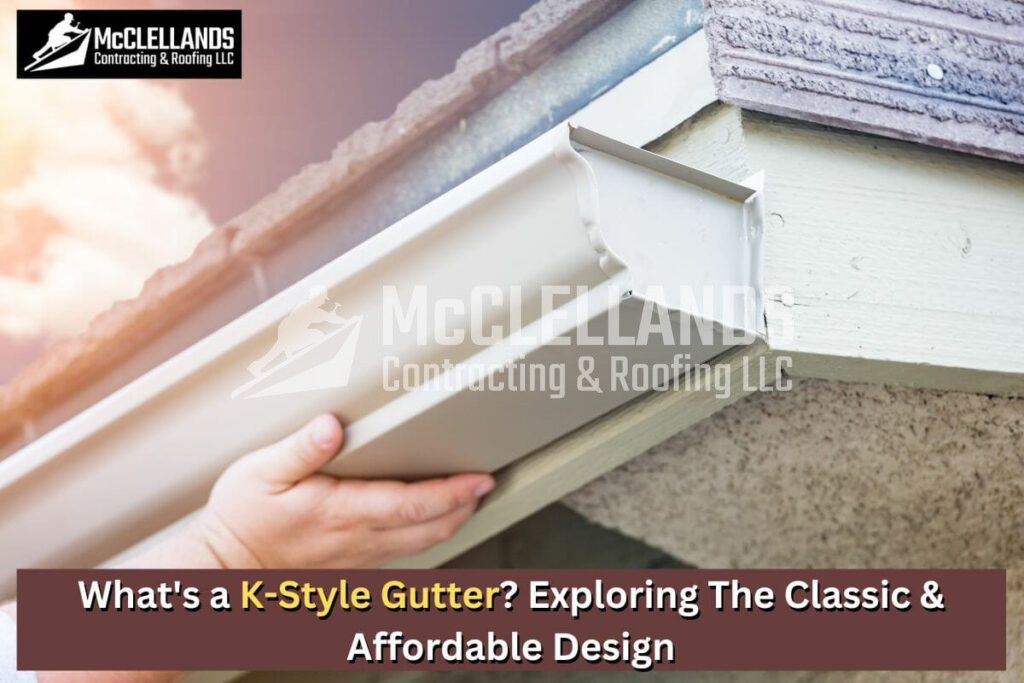
A K-style gutter is a rain gutter profile shaped like the letter “K” when viewed from the side, featuring a flat back that mounts directly to fascia boards and a decorative front with curves that resemble crown molding. K-style gutters are the most popular gutter system in America because they hold 20-30% more water than traditional half-round gutters, install easily without special brackets, and complement both modern and traditional home styles. Available in 5-inch and 6-inch sizes with materials including aluminum, vinyl, copper, and steel, K-style gutters typically cost $8-15 per linear foot installed and can last 20-30 years with proper maintenance.
These versatile gutters excel at protecting homes from water damage while maintaining an attractive appearance that blends seamlessly with various architectural designs. Whether you’re replacing old, failing gutters or installing a system for the first time, understanding K-style gutters helps you make informed decisions about protecting your home investment.
For expert guidance selecting new rain gutters, call us today at (412) 790-1608 for a free consultation and estimate.
What Are K-Style Gutters and How Do They Work?
K-style gutters represent a significant evolution in residential drainage systems, combining functional efficiency with aesthetic appeal.
Understanding the K-Style Design
When viewed from the side, K-style gutters display a distinctive profile that vaguely resembles the letter “K”—hence the name. The design features a flat back for mounting, a flat bottom for water collection, and a decorative front with two opposing curves that create visual interest. This front profile mimics colonial-style crown molding, giving gutters an attractive architectural element rather than appearing purely utilitarian.
The flat back design represents one of K-style gutters’ most significant advantages. Unlike half-round gutters requiring mounting brackets behind the gutter, K-style gutters attach directly to fascia boards with hidden hangers or spikes and ferrules. This direct mounting creates a clean installation that sits tight against your home’s exterior, minimizing gaps where water could escape behind the gutter system.
How K-Style Gutters Became America’s Favorite
K-style gutters emerged in the 1960s alongside advances in industrial metal fabrication and seamless gutter technology. Before this, half-round gutters dominated residential construction, a holdover from when gutters were formed from wood or hand-shaped metal. The development of roll-forming machines that could create complex gutter profiles economically made K-style gutters commercially viable.
Their popularity exploded because they solved multiple problems simultaneously. The increased water capacity handled heavy rainfall better than half-round alternatives. The flat back simplified installation on the straight fascia boards used in modern construction. The decorative front provided aesthetic appeal that homeowners appreciated. Within two decades, K-style gutters became the default choice for residential construction across America.
Today, K-style gutters account for approximately 80-90% of residential gutter installations nationwide. Their widespread adoption means materials, components, and professional installation services are readily available at competitive prices. Most gutter manufacturers standardized their equipment to produce K-style profiles, making replacement parts and custom colors easy to source.
K-Style vs. Ogee Gutters: Same Product, Different Names
You may hear K-style gutters referred to as “ogee gutters.” Both terms describe the same product. “Ogee” is an architectural term meaning “double curve,” referring to the S-shaped profile on the gutter’s decorative front. The terms are interchangeable—contractors and manufacturers use both, though “K-style” dominates in most regions.
What Sizes Do K-Style Gutters Come In?
Selecting appropriate gutter size ensures your drainage system handles your roof’s water volume effectively.
Standard Residential Sizes
5-Inch K-Style Gutters: The most common residential size, 5-inch gutters handle typical roof areas up to approximately 5,500 square feet with moderate rainfall. They’re standard on single-story homes, small two-story homes, and homes in regions with light to moderate annual precipitation. Five-inch gutters cost less than larger alternatives and work well for most applications.
6-Inch K-Style Gutters: Increasingly popular for modern homes, 6-inch gutters handle larger roof areas (up to 7,900 square feet) and heavier rainfall more effectively. They’re recommended for:
- Two-story and larger homes with extensive roof areas
- Steep-pitch roofs that concentrate water flow
- Regions with heavy rainfall or intense summer storms
- Homes surrounded by large trees that drop significant debris
The 20% larger capacity provides peace of mind during severe weather, preventing overflows that damage landscaping and foundations. While 6-inch gutters cost $2-5 more per linear foot than 5-inch alternatives, the enhanced performance often justifies the modest investment.
Commercial and Custom Sizes
7-Inch and 8-Inch K-Style Gutters: These larger profiles suit commercial buildings, industrial facilities, and large residential properties with expansive roof systems. Homes with very steep roofs or properties in areas with extreme rainfall may also benefit from 7-inch gutters. Custom sizes beyond 8 inches can be fabricated for specialized applications, though these require professional assessment and installation.
How to Determine the Right Size for Your Home
Several factors influence optimal gutter sizing:
Roof Area and Pitch:
- Measure your roof’s square footage (length × width for each section)
- Steeper roofs concentrate water flow, requiring larger gutters
- Complex rooflines with valleys may need upsized gutters
Regional Rainfall Intensity:
- Areas with intense summer thunderstorms benefit from 6-inch gutters
- Regions with moderate, steady rainfall can use 5-inch gutters
- Check local building codes for minimum gutter size requirements
Aesthetic Considerations:
- Larger homes visually balance better with 6-inch gutters
- Smaller homes may look disproportionate with oversized gutters
- Match existing gutter sizes when replacing portions of your system
Professional contractors calculate appropriate sizing using roof area, pitch, and local rainfall data. When in doubt, slightly oversizing (choosing 6-inch over 5-inch) provides a safety margin that prevents future overflow issues.
What Materials Are K-Style Gutters Made From?
K-style gutters are manufactured in various materials, each offering distinct advantages, lifespans, and price points.
Material Comparison Guide
| Material | Cost Per Linear Foot | Lifespan | Rust Resistance | Maintenance | Best For |
|---|---|---|---|---|---|
| Vinyl | $3-6 | 10-20 years | Excellent (doesn’t rust) | Minimal | Budget installations, DIY projects, warm climates |
| Aluminum | $6-12 | 20-30 years | Excellent | Low | Most homes, best value overall |
| Galvanized Steel | $8-16 | 15-25 years | Good (with coating) | Moderate | Heavy snow loads, impact-prone areas |
| Copper | $20-40+ | 50-100+ years | Excellent (develops patina) | Minimal | Historic homes, luxury properties, lifetime investment |
| Stainless Steel | $18-30 | 40-50 years | Excellent | Minimal | Coastal properties, corrosive environments |
Aluminum K-Style Gutters: The Popular Choice
Aluminum dominates residential gutter installations for compelling reasons. The material naturally resists rust and corrosion, crucial for systems constantly exposed to water. Aluminum gutters are lightweight, reducing stress on fascia boards while remaining strong enough for residential applications. They’re available in numerous colors through baked-on enamel finishes or can be painted to match your home’s exterior.
Cost-effectiveness makes aluminum particularly appealing—the material provides excellent durability at reasonable prices. Most aluminum gutters last 20-30 years with basic maintenance, delivering strong return on investment. Seamless aluminum gutters (custom-formed on-site) cost only slightly more than sectional alternatives while providing superior leak resistance.
Aluminum’s primary limitation involves denting susceptibility. Falling branches, ladders leaning against gutters, or hail can dent aluminum surfaces. However, these dents typically don’t compromise function—they’re mainly aesthetic concerns. In areas with heavy tree coverage or frequent severe weather, consider heavier-gauge aluminum (.032 inch thickness) for enhanced impact resistance.
Vinyl K-Style Gutters: Budget-Friendly Option
Vinyl (PVC plastic) gutters appeal to budget-conscious homeowners and DIY installers. The material costs significantly less than metal alternatives and installs easily using snap-together components. Vinyl never rusts, eliminates painting needs, and comes in various colors molded throughout the material (scratches don’t show different colors underneath).
However, vinyl has notable limitations. The material becomes brittle in extreme cold, cracking when temperatures drop below 0°F. Intense summer sun causes warping and sagging over time, particularly on long unsupported spans. Vinyl gutters typically last 10-20 years—half the lifespan of aluminum alternatives. They’re best suited for warm climates without extreme temperature swings and for homeowners planning shorter-term occupancy.
Steel K-Style Gutters: Maximum Strength
Galvanized steel gutters provide exceptional strength and impact resistance. They’re heavier than aluminum, requiring substantial fascia support, but this weight translates to durability. Steel gutters resist denting from falling branches, withstand heavy snow loads, and maintain structural integrity under stress.
The galvanized coating (zinc layer) protects steel from rust, though this protection eventually degrades. Expect 15-25 years of service before rust becomes problematic, particularly at seams and fastener points. Steel gutters require more vigilant maintenance than aluminum—inspect annually for rust spots and apply protective coatings as needed. Despite higher maintenance, steel’s strength makes it ideal for areas with heavy snowfall, large trees, or other impact risks.
Stainless steel eliminates rust concerns entirely while maintaining steel’s strength advantages. The material costs significantly more ($18-30 per linear foot) but lasts 40-50 years with minimal maintenance. Stainless steel excels in coastal environments where salt air accelerates corrosion of other metals.
Copper K-Style Gutters: Luxury Choice
Copper gutters represent the premium gutter option, combining stunning aesthetics with exceptional longevity. New copper gleams with bright metallic shine, gradually developing a distinctive green-blue patina over 10-20 years. This patina is protective oxidation that prevents further corrosion—copper gutters can last 50-100+ years, often outlasting the homes they protect.
The initial investment is substantial ($20-40+ per linear foot), making copper gutters most suitable for historic properties, luxury homes, or homeowners committed to long-term ownership. The cost-per-year calculation actually favors copper when amortized over 75-100 year lifespans. Copper gutters also increase property value and enhance curb appeal, particularly on brick, stone, or traditional architectural styles.
Copper requires specialized installation—the material expands and contracts significantly with temperature changes, demanding specific mounting techniques. Always hire experienced professionals for copper gutter installation to ensure proper expansion joint placement and secure mounting that accommodates thermal movement.
What Are the Advantages of K-Style Gutters?
K-style gutters offer numerous benefits that explain their dominance in residential applications.
Superior Water Capacity
The deep, angular design of K-style gutters holds 20-30% more water than equivalent-size half-round gutters. A 5-inch K-style gutter holds approximately 1.2 gallons per linear foot, compared to 0.9 gallons for a 5-inch half-round gutter. This increased capacity prevents overflows during heavy rainfall, protecting foundations, basements, and landscaping from water damage.
The flat bottom design provides stable water collection, while the front curves add depth without increasing the gutter’s visual bulk. This efficient use of space makes K-style gutters particularly effective on homes with limited fascia board depth or where architectural elements restrict gutter size.
Easy Installation and Mounting
K-style gutters’ flat back design revolutionized gutter installation. The flat surface mounts directly to fascia boards using:
Hidden Hangers: Modern installation standard, these brackets fit inside gutters and screw into fascia boards. Hidden hangers create clean lines with no visible hardware, supporting gutters every 16-24 inches along their length.
Spikes and Ferrules: Traditional mounting method using long spikes driven through gutter front, through a tubular ferrule (spacer), into fascia boards. While less common today, this system works effectively on homes with adequate fascia thickness.
Mounting Brackets: For homes without fascia boards (such as exposed rafter designs), specialized brackets attach to roof framing. These work with K-style gutters’ flat backs to create secure mounting.
The direct mounting eliminates the strap hangers and brackets required for half-round gutters, reducing installation time and costs. DIY-capable homeowners can install sectional K-style gutters with basic tools and moderate skill, though professional installation ensures proper slope and secure mounting.
Attractive Appearance
K-style gutters’ decorative front profile mimics classical crown molding, providing visual interest that complements various architectural styles. The curves and angles create shadows and dimension, making gutters architectural features rather than obvious drainage components.
This versatility means K-style gutters look appropriate on:
- Modern and contemporary homes with clean, angular lines
- Traditional colonials and Cape Cod styles with period detailing
- Ranch homes and split-levels with straightforward designs
- Tudor and craftsman styles with complex roof lines
Available colors range from standard white, brown, and black to custom hues matching specific exterior palettes. The ability to color-match gutters to trim, siding, or roofing creates cohesive appearances that enhance curb appeal.
Material and Design Flexibility
K-style profiles work in all common gutter materials—aluminum, vinyl, steel, and copper. This flexibility lets homeowners choose materials based on budget, climate, and aesthetic preferences while maintaining consistent K-style appearance. Sectional and seamless options provide further customization:
Sectional K-Style Gutters:
- Pre-cut 10-20 foot sections
- DIY-friendly installation
- Lower upfront cost
- Easier repairs (replace damaged sections)
- More seams = higher leak potential
Seamless K-Style Gutters:
- Custom-formed on-site to exact lengths
- Professional installation required
- Higher initial cost
- Minimal seams (only at corners and downspouts)
- Reduced leak risk and maintenance
Cost-Effectiveness
K-style gutters’ popularity drives competitive pricing through widespread availability. Materials cost less due to economy of scale. Installation costs remain reasonable because contractors efficiently work with familiar systems. Replacement components, color-matched sections, and repair parts are readily available at competitive prices.
The combination of moderate initial cost, long lifespan (20-30 years for aluminum), and reduced maintenance creates excellent overall value. When properly installed and maintained, K-style gutters deliver reliable performance for decades at costs that fit most homeowner budgets.
What Are the Disadvantages of K-Style Gutters?
Despite numerous advantages, K-style gutters have some limitations worth considering.
More Difficult to Clean Than Round Gutters
The angular design and corners of K-style gutters create areas where debris accumulates more readily than in smooth half-round gutters. Leaves, twigs, and pine needles can lodge in the curves and angles, requiring more thorough cleaning to remove all material. The flat bottom also retains some water after rainfall, which can contribute to sediment buildup over time.
This cleaning challenge becomes more pronounced in areas with heavy tree coverage. Homeowners near oak, maple, pine, or other prolific leaf-droppers may need to clean K-style gutters 3-4 times annually compared to twice-yearly maintenance for properties with minimal trees.
Solution: Gutter guards significantly reduce cleaning frequency by preventing debris entry while allowing water flow. Many guard systems designed specifically for K-style gutters use the gutter’s front curve as mounting points. Quality gutter guards cost $4-25 per linear foot but can reduce annual cleaning from multiple times to once every 2-3 years.
Standing Water Can Accelerate Corrosion
The flat bottom design that improves water capacity also means K-style gutters retain small amounts of water after rainfall. This standing water, combined with debris accumulation, creates conditions that accelerate corrosion in metal gutters (particularly galvanized steel). The corners and angles provide additional areas where moisture and organic material can accumulate, potentially shortening gutter lifespan without proper maintenance.
Aluminum gutters naturally resist corrosion better than steel alternatives, minimizing this concern. Regular cleaning removes debris that traps moisture. Ensuring proper gutter slope (1/2 inch per 10 feet toward downspouts) allows complete drainage, preventing standing water.
Limited Aesthetic Appeal for Historic Properties
While K-style gutters complement most architectural styles, they may look out of place on certain historic properties. Homes built before the 1960s originally featured half-round gutters that match their period architecture. Victorian, Georgian, Federal, and other pre-modern styles often look more authentic with half-round profiles.
Historic preservation guidelines for landmark properties may specifically require half-round gutters to maintain historical accuracy. Before installing K-style gutters on homes over 70 years old, particularly those in historic districts, verify that modern gutter profiles won’t violate preservation standards or reduce property value.
For historic properties without preservation restrictions, homeowners must balance the practical advantages of K-style gutters against aesthetic authenticity. Some choose to sacrifice slight functional efficiency for historically appropriate appearances.
Should You Choose Sectional or Seamless K-Style Gutters?
K-style gutters come in two primary designs—sectional and seamless—each with distinct characteristics affecting cost, installation, performance, and maintenance.
Sectional K-Style Gutters: Traditional Approach
Sectional gutters arrive in pre-cut sections (typically 10-20 feet) that connect using coupling joints, screws, and sealant.
Advantages of Sectional Gutters:
Budget-Friendly: Sectional gutters cost $3-8 per linear foot for materials, making them the most economical option. Lower material costs plus DIY installation potential creates significant savings.
DIY-Capable Installation: Homeowners with basic tools and moderate DIY skills can install sectional gutters. Pre-cut sections are manageable without specialized equipment. However, installation requires:
- Helper for positioning long sections safely
- Proper slope calculation (1/2 inch per 10 feet)
- Secure mounting every 16-24 inches
- Careful sealing at all joints
Easy Section Replacement: Damaged sections can be replaced individually without disturbing the entire gutter run. This flexibility reduces repair costs when specific sections sustain damage from falling branches, ice, or other impacts.
Disadvantages of Sectional Gutters:
Multiple Leak Points: Each joint between sections creates potential leak locations. Sealant at connections eventually degrades, allowing water to escape. Most sectional gutter failures occur at seams rather than within gutter sections themselves.
Higher Maintenance Requirements: Joints collect debris and require inspection/resealing every 2-3 years to maintain watertight performance. More frequent cleaning prevents debris buildup at seams that accelerates sealant failure.
Reduced Structural Integrity: Connections create weak points where gutters can separate under stress from ice accumulation, heavy water loads, or impacts. Joint failures during severe weather can lead to entire gutter sections pulling away from homes.
Less Attractive Appearance: Visible seams every 10-20 feet create less polished aesthetics than seamless alternatives. Color-matched joints minimize this visual impact but cannot eliminate it entirely.
Seamless K-Style Gutters: Modern Solution
Seamless gutters are custom-formed on-site using truck-mounted roll-forming machines that create continuous gutter lengths up to 50+ feet without seams.
Advantages of Seamless Gutters:
Minimal Leak Potential: Seamless gutters only have seams at corners, downspout connections, and end caps—the absolute minimum needed for functional systems. This dramatic reduction in seam count (from potentially 10+ seams to 2-3 per run) nearly eliminates leak risks.
Reduced Maintenance: Fewer seams mean fewer areas where debris accumulates and fewer locations requiring regular inspection and resealing. Most homeowners find seamless gutters need only annual cleaning versus quarterly attention for sectional alternatives.
Enhanced Durability: Continuous construction without weak joints creates stronger gutters that resist separation during ice expansion, heavy water loads, and storm stress. Seamless gutters rarely fail catastrophically—they’re more likely to reach end-of-life gradually through material degradation rather than sudden joint failures.
Superior Appearance: Seamless gutters provide clean, streamlined looks without visible interruptions. This polished appearance enhances curb appeal and makes gutters less visually prominent—they blend into architecture rather than drawing attention.
Custom Fit: On-site fabrication creates gutters cut precisely for your home’s dimensions, eliminating the measurement compromises sometimes necessary with pre-cut sectional lengths.
Disadvantages of Seamless Gutters:
Higher Initial Cost: Seamless gutters cost $8-15 per linear foot installed—typically 50-100% more than sectional alternatives. The custom fabrication and professional installation drive this premium pricing.
Professional Installation Required: Creating seamless gutters requires specialized roll-forming equipment worth $15,000-40,000 that only professional contractors own. This eliminates DIY installation as an option.
More Complex Repairs: Damaged sections often require replacing entire gutter runs rather than individual sections. While seamless gutters need repairs less frequently, costs can be higher when repairs are necessary.
Making Your Decision
Consider these factors when choosing between sectional and seamless K-style gutters:
Choose Sectional Gutters If:
- Budget is primary concern
- You have DIY skills and want to self-install
- The home is temporary residence (5-10 years)
- Frequent repairs aren’t concerning
Choose Seamless Gutters If:
- Long-term performance matters most
- You want minimal maintenance requirements
- Property value and appearance are important
- Budget allows for quality investment
Most contractors recommend seamless gutters for their superior long-term performance despite higher upfront costs. The reduced maintenance and repair needs over 20-30 year lifespans often offset initial investment. However, sectional gutters remain viable for budget-constrained situations or temporary housing.
How Do K-Style Gutters Compare to Other Gutter Types?
Understanding how K-style gutters stack up against alternatives helps you make informed decisions.
K-Style vs. Half-Round Gutters
| Feature | K-Style Gutters | Half-Round Gutters |
|---|---|---|
| Water Capacity | Higher (1.2 gal/ft for 5″) | Lower (0.9 gal/ft for 5″) |
| Installation | Direct fascia mounting | Requires mounting brackets |
| Appearance | Crown molding look, modern | Classic semicircle, traditional |
| Cleaning Ease | More difficult (corners trap debris) | Easier (smooth interior) |
| Cost | Lower ($6-12/ft aluminum) | Higher ($9-17/ft aluminum) |
| Best For | Most homes, heavy rainfall areas | Historic homes, aesthetic preference |
| Debris Handling | Corners can trap material | Smooth flow, less accumulation |
| Strength | Excellent with K-profile shape | Good, rounded shape resists denting |
When to Choose K-Style Over Half-Round:
- Budget is important consideration
- Rainfall volume requires maximum capacity
- Modern/contemporary architecture
- Fascia boards allow direct mounting
- DIY installation desired (sectional versions)
When to Choose Half-Round Over K-Style:
- Historic property preservation
- Preference for traditional aesthetics
- Easier cleaning outweighs capacity needs
- Luxury or custom home construction
- Brick, stone, or slate exteriors
K-Style vs. Box Gutters
Box gutters integrate directly into roof structures, hidden behind facade boards or within roof framing.
Box Gutter Characteristics:
- Completely hidden from ground view
- Maximum water capacity (larger than K-style or half-round)
- Integrated into building structure
- Common on commercial buildings and flat roofs
- Requires professional installation during construction
- Difficult to add to existing homes
- Expensive repairs if leaks develop
When Box Gutters Make Sense:
- New construction or major renovation
- Commercial/industrial buildings
- Flat or very low-pitch roofs
- Architectural designs hiding gutters
- Properties with extensive roof areas
Most residential properties benefit more from K-style or half-round gutters than box gutters due to easier installation, simpler maintenance, and lower costs. Box gutters remain specialized solutions for specific architectural or functional requirements.
How Much Do K-Style Gutters Cost?
Understanding cost factors helps you budget appropriately and evaluate contractor quotes.
Material and Installation Costs
Average K-Style Gutter Costs (Installed):
| Material | Sectional Cost/Linear Foot | Seamless Cost/Linear Foot |
|---|---|---|
| Vinyl | $3-6 | $4-8 |
| Aluminum | $6-9 | $8-15 |
| Galvanized Steel | $8-12 | $10-18 |
| Copper | $20-30 | $25-40+ |
These costs include materials, professional labor, hangers/mounting hardware, downspouts, and basic downspout extensions. Regional variations affect pricing—expect 10-30% higher costs in major metropolitan areas and coastal regions with higher labor rates.
Factors Affecting Total Project Cost
Linear Footage Required: Average single-story homes need 120-200 linear feet of gutter. Two-story homes typically require 200-300+ linear feet. Measure your home’s perimeter to estimate material needs.
Gutter Size (5-inch vs. 6-inch): Six-inch gutters cost $2-5 more per linear foot than 5-inch equivalents due to increased material and slightly more complex installation.
Number of Downspouts: Each downspout adds $50-150 to project costs including outlet, elbows, mounting brackets, and installation. Homes typically need one downspout for every 30-40 feet of gutter run.
Fascia Condition: Rotted or damaged fascia requires repair before gutter installation. Fascia board replacement costs $6-20 per linear foot depending on material and extent of damage.
Existing Gutter Removal: Removing old gutters typically costs $1-3 per linear foot. Some contractors include removal in installation quotes; others charge separately.
Story Height: Second-story gutter installation costs 30-50% more than ground-level work due to equipment requirements, increased labor difficulty, and additional safety precautions.
Gutter Guards: Adding gutter protection during installation costs $4-25 per linear foot depending on guard quality and style. While this increases upfront investment, guards reduce future cleaning costs and maintenance time.
Sample K-Style Gutter Project Costs
1,500 sq ft Ranch Home (Single Story):
- 140 linear feet of 5″ aluminum seamless K-style gutters
- 4 downspouts with extensions
- Basic gutter guards
- Removal of old gutters
- Total Cost: $1,400-2,400
2,500 sq ft Colonial (Two Story):
- 240 linear feet of 6″ aluminum seamless K-style gutters
- 7 downspouts with extensions
- Premium gutter guards
- Fascia board repairs (25 linear feet)
- Total Cost: $3,200-5,800
3,500 sq ft Custom Home:
- 280 linear feet of 6″ copper seamless K-style gutters
- 8 downspouts with buried extensions
- No gutter guards (copper debris slides easily)
- Total Cost: $9,000-15,000
Are K-Style Gutters Worth the Investment?
K-style gutters protect homes from water damage that costs thousands to repair:
Foundation Repairs: $4,000-15,000 for foundation settling, cracks, or water infiltration Basement Waterproofing: $3,000-10,000 for comprehensive systems Fascia/Soffit Replacement: $6-20 per linear foot for rot repair Landscaping Restoration: $500-3,000 for erosion repair and replanting
Quality gutter systems costing $1,500-4,000 prevent damage costing 5-10 times that amount. When viewed as foundation and structural protection rather than simple rain management, K-style gutters represent excellent value that pays for itself many times over during their 20-30 year service lives.
How Do You Maintain K-Style Gutters?
Proper maintenance maximizes gutter lifespan and ensures reliable performance protecting your home.
Essential Maintenance Schedule
Twice-Annual Cleaning (Spring and Fall):
- Remove leaves, twigs, and accumulated debris
- Flush gutters with garden hose
- Clear downspout outlets and extensions
- Inspect for damage, leaks, or sagging
After Major Storms:
- Check for impact damage from fallen branches
- Verify gutters remain securely attached to fascia
- Ensure downspouts didn’t shift or disconnect
- Look for overflow evidence indicating clogs
Annual Detailed Inspection:
- Examine all corners and end caps for seal integrity
- Check mounting hardware remains tight
- Look for rust spots or paint deterioration
- Verify proper slope hasn’t changed due to settling
- Inspect fascia boards behind gutters for rot
Every 3-5 Years:
- Reseal corners, end caps, and downspout connections
- Touch up paint on scratched or chipped areas
- Clean gutter exteriors to maintain appearance
- Adjust mounting if any sagging developed
Maintenance Tips for Different Materials
Aluminum K-Style Gutters:
- Touch up scratches promptly to prevent oxidation
- Clean with mild soap and water (avoid abrasive cleaners)
- Check for loose fasteners annually
- Repaint every 10-15 years if paint fades
Vinyl K-Style Gutters:
- Inspect for cracks in cold climates
- Clean regularly to prevent UV damage to debris-stained areas
- Check mounting clips remain secure
- Replace brittle sections before they crack completely
Steel K-Style Gutters:
- Watch for rust at seams and fastener points
- Apply rust-inhibiting paint to suspicious areas promptly
- Ensure protective coating remains intact
- Consider professional re-coating every 10-15 years
Copper K-Style Gutters:
- Clean annually to maintain even patina development
- Inspect soldered seams for integrity
- Verify expansion joints function properly
- No painting or coating needed
Signs Your K-Style Gutters Need Professional Attention
Immediate Repair Needs:
- Visible leaks at corners or seams
- Sections pulling away from fascia
- Significant dents or impact damage
- Holes or rust-through spots (steel gutters)
- Cracks in material (vinyl or aluminum)
Consider Replacement When:
- Multiple sections show corrosion or deterioration
- Gutters age beyond 25-30 years (aluminum/steel)
- Frequent repairs needed annually
- Fascia boards show rot behind gutters
- Persistent leaking despite repairs
- Foundation shows water damage from gutter failures
Early attention to minor issues prevents expensive repairs. A $150-300 professional inspection and repair costs far less than the $5,000-15,000 foundation work resulting from neglected gutter problems.
Get Professional K-Style Gutter Installation
Choosing the right gutter system protects your home from water damage while enhancing its appearance. K-style gutters offer an ideal combination of efficiency, aesthetics, and affordability that explains their popularity across America.
At McClellands Contracting and Roofing, LLC, our team of skilled professionals specializes in quality K-style gutter installations that provide lasting protection. With years of experience in the home improvement industry, we understand how to select appropriate materials, size gutters correctly, and install systems that perform reliably for decades.