

 Residential
 Commercial
 Interior
 Exteriors
 Service Areas
 Contact Us
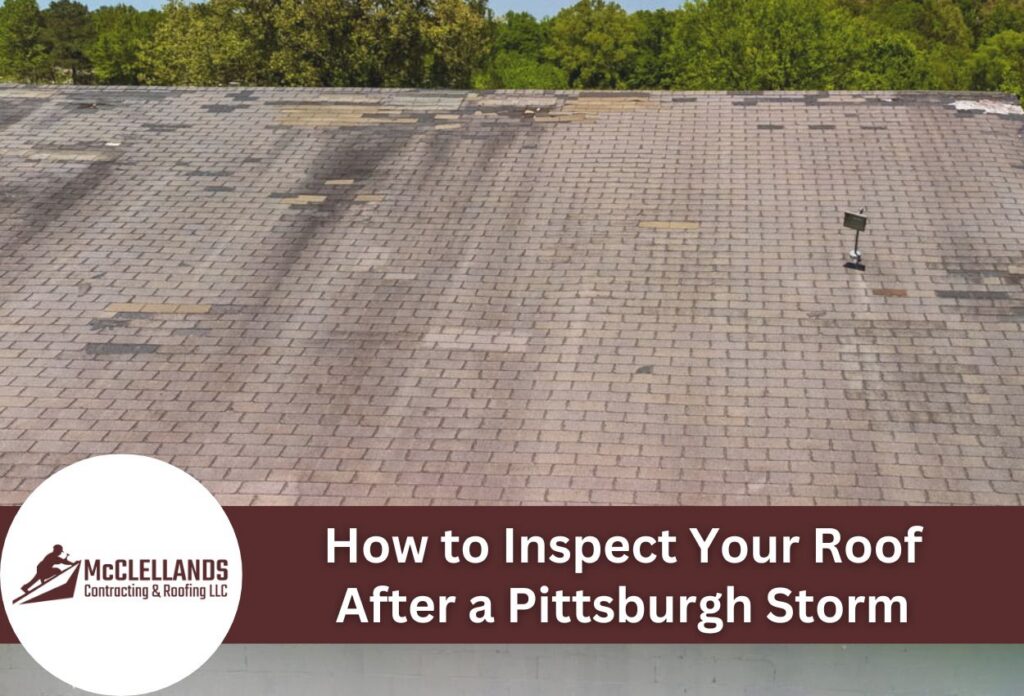

After a storm damages your roof, do a ground-level visual check within 24 to 72 hours, then call a professional roofer if you spot any damage indicators. Acting fast in that window improves your insurance claim documentation and helps prevent small problems from turning into expensive water damage inside your home.
Pittsburgh averages 38 to 40 inches of precipitation per year, with thunderstorms that can push wind gusts past 50 mph, periodic hail, and winter temperature changes that crack and loosen shingles over time.
*Please note, price ranges listed in this article may not reflect the final cost of your project. Prices are subject to change based on various factors such as local labor rates, material quality, and more. All costs established in this article are rough estimates based on average industry rates.
How Do You Safely Inspect Your Roof After a Hail or Wind Storm in Pittsburgh?
Stand at least 10 to 15 feet back from your home and use binoculars. Ground-level view is the safest starting point for any post-storm inspection, and it covers more than most homeowners expect.
- Ground-level visual check: From 10 to 15 feet back, scan the entire roofline with binoculars for missing shingles, lifted edges, dented metal vents, and displaced flashing. Look for dark patches or uneven texture that may signal hail impact or granule loss.
- Gutter and downspout check: Walk the perimeter and look inside gutters for heavy granule buildup. A high volume of granules after a single storm is a measurable sign that shingles took impact damage. Check downspouts for dents or separation at joints from wind or debris.
- Slope assessment before any roof walking: Do not walk on any roof with a pitch steeper than 4:12 without professional equipment. Pittsburgh’s steep-slope gable and hip roofs commonly range from 6:12 to 12:12 pitch, which makes DIY walking unsafe for most local homes.
- Attic inspection indoor check: Go into the attic with a flashlight and look for daylight seeping through roof boards, water staining on rafters, and wet or compressed insulation near the eaves or valleys. Pittsburgh’s older wood-framed homes have higher rates of hidden deck deterioration, making the attic check one of the most valuable steps you can take without leaving the house.
- Document everything before repairs: Take dated photos of every damage indicator found at ground level, and in the attic, within 24 to 72 hours of the storm, as that window matters for insurance documentation.
If any attic or ground-level check turns up damage, stop there and call a professional. Pittsburgh’s steep rooflines are not safe for untrained foot traffic, and a missed hidden leak can cause far more damage than the original storm.
What Are the Signs of Roof Damage After Heavy Rain, Hail, and Wind in Pittsburgh?
Granule accumulation exceeding ¼ inch depth at downspout discharge, missing or lifted shingles, and water stains at valleys are the three most telling signs of storm damage on Pittsburgh roofs. Each storm type leaves a different footprint, and knowing which component to check first saves time and helps support an insurance claim. Wind-driven rain at speeds above 45 mph can force water under shingles even without any visible exterior shingle damage, making signs of roof damage after heavy rain in Pittsburgh easy to miss if you only look from the outside.
| Storm Type | Roof Components Most Affected | Visible Damage Indicator | Repair Urgency |
|---|---|---|---|
| Hail | Shingles, metal vents, gutters | Granule buildup at downspouts, bare spots on shingles, and dented metal vents | Within 7 days |
| High Wind | Shingles, chimney flashing, ridge cap | Lifted, curled, or missing shingles: loosened chimney flashing: debris impact marks | Immediate |
| Heavy Rain | Valleys, step flashing, gutters | Water intrusion stains at valleys, separated step flashing, and gutters overflowing from clogs. | Within 7 days |
Any storm combining wind gusts above 45 mph with heavy rain creates a hidden water intrusion risk that does not show up as exterior shingle damage, attic water stains, or wet insulation near valleys, which are often the only early clue. If any of these indicators turn up during your ground-level or attic check, a professional roof storm damage inspection is the logical next step before conditions get worse or a follow-up storm adds to the damage.
Which Roof Components Are Most Vulnerable on Pittsburgh’s Older Homes?
Chimney flashing, roof valleys, dormer intersections, and soffit edges fail first on Pittsburgh’s older housing stock, and homes built before 1970 face a higher risk because many still have single-layer roof decking, aged step flashing, and original masonry chimneys that take repeated hits from temperature changes each winter.
Asphalt shingles carry an expected lifespan of 20 to 30 years under normal conditions. But Pittsburgh’s average relative humidity is near 70%, recurring ice dams, and UV exposure commonly cut that down to 18 to 22 years in practice. That gap matters. In older neighborhoods like Lawrenceville, Shadyside, or Mt. Washington, many homes may already be carrying a roof near the end of its life before a storm ever makes contact.
A roof that is already at 18 to 22 years on Pittsburgh’s weather cycle may look functional on the surface, but has weakened flashing seals, brittle underlayment, and soft roof decking at the valleys, all of which fail faster under storm stress than a newer installation would.
Slate and Wood Shake Roofs Require a Different Assessment
Some Pittsburgh homes, particularly those from the late 1800s and early 1900s, still carry original slate or wood shake roofs. These materials fail differently from asphalt and should only be assessed by a specialist familiar with their behavior. Replacement costs for slate and wood shake run $15 to $30 per square foot, compared to $4 to $8 per square foot for asphalt shingles. Getting a general roofer’s opinion on either material without that specialty knowledge can lead to misdiagnosis and unnecessary full replacement when targeted residential roof repairs may still be viable.
What Does a Pittsburgh Roof Inspection Cost, and When Does Repair Pay Off?
Most Pittsburgh roofing contractors offer post-storm inspections for $0 to $150, making early assessment one of the lowest-cost steps a homeowner can take and the one with the highest potential return if damage is found quickly.
| Scenario | Typical Pittsburgh Cost | Cost of Delaying One Season |
|---|---|---|
| Professional post-storm inspection | $0 to $150 | Risk of undetected damage adding up through the winter |
| Minor repair (flashing, a few shingles) | $200 to $500 | $1,500 to $10,000+ in interior water damage |
| Moderate repair (partial section replacement) | $800 to $2,500 | $2,000 to $5,000+ in deck and framing damage |
| Full roof replacement | $8,000 to $15,000 | Higher structural repair costs if the deck failure spreads |
A flashing failure that costs $200 to $500 to fix today can produce $1,500 to $10,000+ in interior water damage if left open through a Pittsburgh winter. That gap is the core argument for acting fast after any storm. Pennsylvania homeowners filing insurance claims for hail or wind damage typically have a reporting window of 1 year from the storm, though that window varies by insurer, so documentation should start within 24 to 72 hours. A $0 to $150 inspection that catches a minor flashing failure before winter sets in is almost always the lowest-cost outcome available.
Should You File an Insurance Claim or Pay Out of Pocket After a Pittsburgh Storm Roof Damage?
File a claim only if your estimated repair cost exceeds your deductible by a meaningful margin. Pennsylvania homeowners’ insurance deductibles typically range from $500 to $2,500, and claims under $1,000 to $1,500 may not justify filing once potential premium increases are factored in.
- Compare repair cost to your deductible: Get a written estimate before calling your insurer. If your repair falls between $200 to $500 for minor flashing or shingles, paying out of pocket likely costs less than a claim-driven premium increase over the next 3 to 5 years.
- Count your prior claims: Two or more claims filed within the last 3 years can trigger a non-renewal notice or a rate increase in Pennsylvania, and history matters before you add another claim to your record.
- Confirm the damage is storm-caused, not maintenance-related: Pennsylvania homeowners’ insurance does not cover damage from lack of maintenance or normal wear. Insurers actively distinguish between storm damage and pre-existing deterioration, making a licensed contractor’s written inspection report with dated photos the single most important document you can have before filing.
- Verify a licensed contractor has documented the damage in writing: Dated photos taken within 24 to 72 hours of the storm, combined with a professional written report, give your adjuster a clear record that separates new storm damage from older wear.
- Check whether the storm was declared in Allegheny County: A declared storm creates a documented record that supports your claim timeline and reduces the chance your insurer labels the damage as pre-existing.
Run through all five criteria before making a decision. If repair costs clearly exceed your deductible, damage is confirmed as storm-caused, and a licensed contractor has documented everything in writing, filing a claim is the logical next step.
Ready to Have Your Pittsburgh Roof Inspected by a Professional?
A missed hidden leak found within the 24 to 72 hour documentation window costs far less to fix than one that sits through a Pittsburgh winter, and McClellands Contracting and Roofing, LLC knows exactly what to look for on the older homes, steep rooflines, and mixed-material systems common across Allegheny County.
Schedule your free roof inspection
Not ready to schedule? Learn more about post-storm roof inspections in Pittsburgh.