

 Residential
 Commercial
 Interior
 Exteriors
 Service Areas
 Contact Us
Standing Seam vs. Exposed Fastener Metal Roofing Systems for Pittsburgh Homes
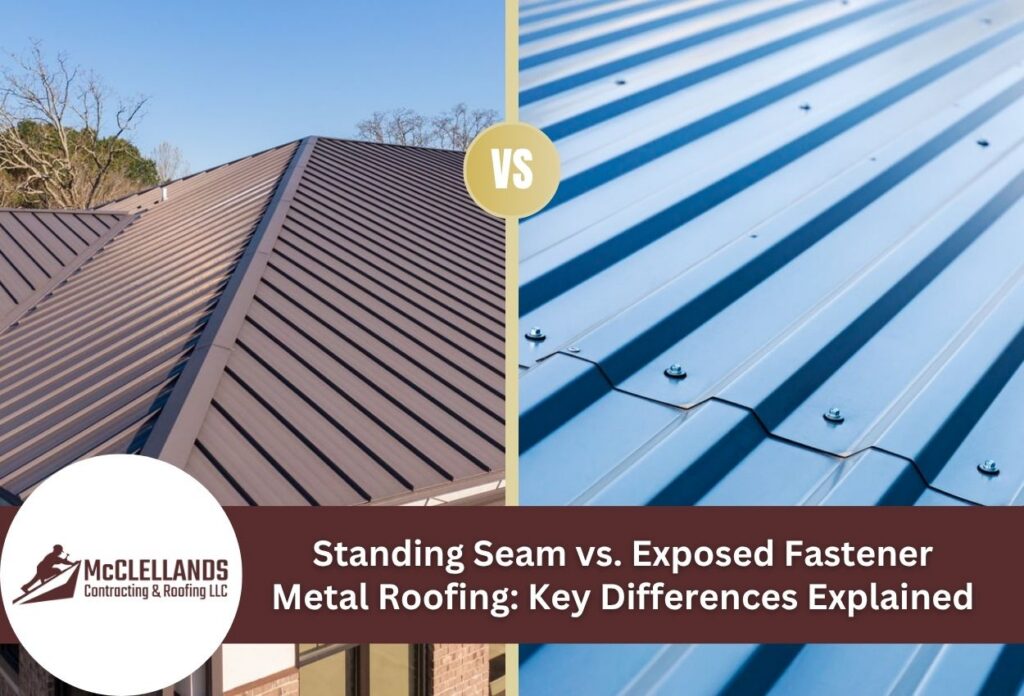

Standing seam metal roofing uses concealed clips with zero exposed gaps through the panel face, while exposed fastener panels use visible screws typically spaced every 12 to 24 inches across the panel field that pass directly through the metal surface. Standing seam panels lock together at raised seams and float on clips, so no fastener ever touches the weather. Exposed fastener panels gap down through the face, with only an EPDM rubber washer standing between that penetration and Pittsburgh’s rain, snow, and temperature swings.
That difference matters here. Pittsburgh receives 38 to 40 inches of annual precipitation and 40 or more inches of seasonal snowfall, and the region cycles through repeated heating and cooling across fall, winter, and early spring. Those conditions put direct stress on every exposed screw point over time, making fastener exposure a real performance variable, not just a cosmetic distinction between two panel styles.
How Do Standing Seam and Exposed Fastener Systems Compare on Performance and Durability?
Standing seam metal roofing systems last 40 to 70 years in Pittsburgh conditions, while exposed fastener panels typically reach 20 to 35 years before significant maintenance or replacement is needed.
| Performance Factor | Standing Seam | Exposed Fastener |
|---|---|---|
| Expected Lifespan | 40 to 70 years | 20 to 35 years |
| Fastener Exposure | Zero exposed gaps through panel face | Screws every 12 to 24 inches through panel face |
| Thermal Movement Accommodation | Floating clips allow panels up to 40 feet to expand and contract freely | Fixed screws restrict panel movement; buckling and elongated holes develop over time |
| Snow and Ice Performance | Smooth panel face sheds snow; pairs well with snow retention systems | Exposed screw heads collect ice and debris; faster washer degradation at contact points |
| Typical Warranty Range | 30 to 40 year paint and finish warranty | 20 to 30 year paint and finish warranty |
| Maintenance Frequency | Low: inspection every 5 to 10 years recommended | Moderate to high: washer and fastener check every 5 years recommended; re-fastening commonly needed at 15 to 20 years. |
The fastener row is where Pittsburgh’s climate creates the sharpest gap between these two systems. EPDM washers on exposed screw-down panels typically degrade within 15 to 20 years, and Pittsburgh’s repeated temperature swings roughly 60 degrees to 70 degrees Fahrenheit between summer highs and winter lows accelerate mechanical thermal slotting and washer compression failure at every penetration point. Most contractors find that re-fastening or washer replacement becomes necessary somewhere in the 15 to 20 year range on exposed fastener roofs in this region.
Standing seam floating clip systems handle that same thermal movement without stressing a single fastener, because panels up to 40 feet long can expand and contract freely a direct advantage on Pittsburgh homes where seasonal temperature swings put constant mechanical pressure on fixed screw points.
What Are the Real Cost Differences Between Standing Seam and Exposed Fastener Metal Roofing Systems?
Standing seam metal roofing systems run $600 to $1,000 per square installed, roughly double the $300 to $500 per square installed cost of exposed fastener panels, but long-term maintenance costs narrow that gap more than most homeowners expect.
| System Type | Material Cost per Square | Labor Cost per Square | Total Installed Cost per Square | Typical 2,000 sq ft Roof Total |
|---|---|---|---|---|
| Exposed Fastener | $150 to $250 | $150 to $250 | $300 to $500 | $6,000 to $10,000 |
| Standing Seam | $350 to $600 | $250 to $400 | $600 to $1,000 | $12,000 to $20,000 |
| Exposed Fastener Long-Term Add-Ons | $500 to $1,500 washer/fastener service at 15 to 20 years; $300 to $800 per leak repair incident | Lifetime cost gap with standing seam narrows after first major service cycle. |
The upfront savings on exposed fastener panels are real, but the math shifts once maintenance enters the picture. Washer replacement and re-fastening at the 15 to 20 year mark typically runs $500 to $1,500, and any leak that develops at a failed screw point adds $300 to $800 per incident on top of that. Pittsburgh permit costs for residential re-roofing also vary by municipality but generally fall in the $100 to $400 range, and both systems must comply with Pennsylvania IRC requirements for roof covering and flashing, so budget for that regardless of which panel type is chosen.
For a 2,000 sq ft Pittsburgh home, the $6,000 to $10,000 installed cost of exposed fastener panels looks appealing upfront, but repeated maintenance cycles over 35 years can push lifetime costs closer to standing seam’s $12,000 to $20,000 range. Homeowners planning to stay long-term should factor that full picture into the decision.
Are Standing Seam or Exposed Fastener Metal Roofing Systems Harder to Install on Pittsburgh’s Steep-Slope Roofs?
Standing seam is harder to install. It requires electric seaming tools that cost $2,000 to $5,000 to rent or own, plus trained crews who know how to run them correctly. Exposed fastener panels can be installed by general roofing contractors using standard tools, which means more contractors in the Pittsburgh market can take on the job and labor costs reflect that wider availability.
Pittsburgh roofs add another layer of difficulty for both systems. Common pitches in the area run from 6:12 to 12:12, and most homes include dormers, chimneys, and wall intersections that require detailed flashing work. Standing seam’s concealed clip design gives installers more flexibility at panel terminations on those complex roof planes. Exposed fastener panels demand precise screw placement on angled decks. Over-driving or under-driving screws on a steep surface compresses or misses the washer seal, creating leak points before the roof is even a year old.
On any Pittsburgh roof steeper than 3:12, both systems require snow retention devices. Snow guards typically run $3 to $8 per linear foot installed, but the attachment method differs in a way that matters for the panel’s structural integrity. Standing seam panels accept clamp-on snow guards that attach to the raised seam without any gap through the panel face. Exposed fastener roofs need additional screw-in anchors, adding more gaps to a system that already relies on washers to keep water out. On a 40-foot roof run at the higher end of Pittsburgh’s pitch range, that difference in snow guard attachment adds up across the full perimeter of the snow retention layout.
Which Metal Roofing System Is Better for Residential Homes and Which Belongs on Barns or Commercial Buildings?
Standing seam is the right choice for occupied residential homes, while exposed fastener panels, including corrugated metal, are better suited to barns, outbuildings, and budget-driven projects where periodic maintenance is acceptable. The table below matches project type to the recommended system and explains why.
| Project Type | Recommended System | Why |
|---|---|---|
| Residential steep-slope home | Standing seam | Zero fastener gaps through the panel face; 40 to 70 year lifespan with low maintenance |
| Detached garage or outbuilding | Either, budget-dependent | Lower occupancy risk makes exposed fastener viable; standing seam extends service life if budget allows |
| Agricultural barn or pole building | Exposed fastener | Lower upfront cost fits agricultural budgets; $300 to $500 per square installed suits large, simple roof planes |
| Low-slope commercial (2:12 to 3:12 pitch) | Standing seam strongly preferred | Concealed clip system handles thermal movement and reduces ponding leak risk on shallow pitches |
| Rental property or budget re-roof | Exposed fastener with maintenance plan | $6,000 to $10,000 installed cost on a 2,000 sq ft roof works for short-hold investments; schedule washer checks every 5 years |
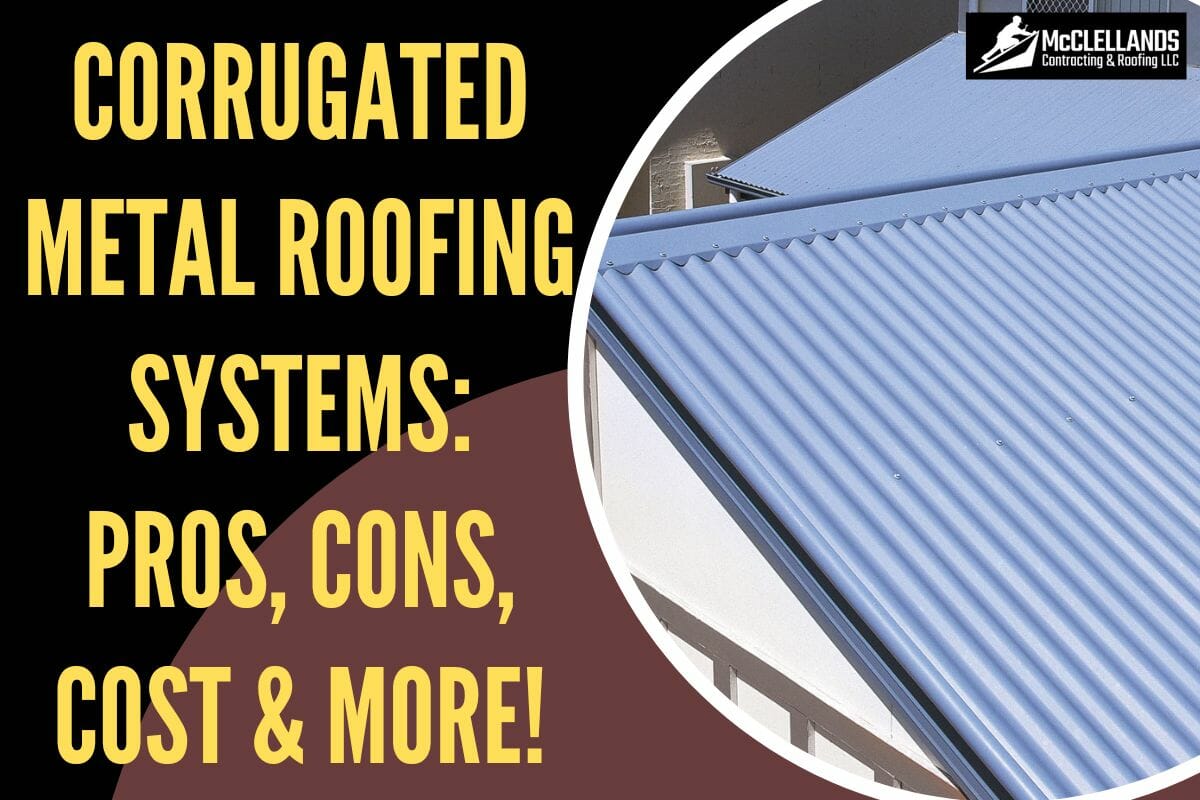
Corrugated metal panels fall inside the exposed fastener category; they use the same face-screw attachment method and carry the same washer degradation risks. They are not recommended as a primary roofing system on occupied Pittsburgh homes. Pittsburgh receives 38 to 40 inches of annual precipitation, and that level of moisture exposure accelerates failure at every exposed screw point over time.
If you plan to own the home for 20 or more years, standing seam’s lower lifetime maintenance cost typically justifies the higher upfront investment over exposed fastener panels. Use these five criteria to make the call:
- Roof pitch: Pitches below 3:12 require structural standing seam; exposed fastener panels shed water poorly on shallow slopes, and architectural standing seam requires at least 3:12
- Roof complexity: More than two or three gaps or valleys favor standing seam’s flexible panel terminations
- Ownership duration: Plans to stay 10 years or fewer make exposed fastener’s $6,000 to $10,000 range reasonable; 20+ years tilts the math toward standing seam
- Maintenance tolerance: Exposed fastener requires a fastener and washer check every 5 years and likely re-fastening at 15 to 20 years; standing seam needs inspection every 5 to 10 years
- Budget ceiling: If the budget cannot reach $12,000 to $20,000 for a 2,000 sq ft roof, exposed fastener with a scheduled maintenance plan is the practical path forward
McClellands Contracting and Roofing, LLC can assess your roof’s pitch, complexity, and long-term fit to help you decide which system makes sense before any materials are ordered. Our residential roof inspection service covers all the variables that determine which panel system performs best for your specific home.
What Is the Long-Term ROI of Standing Seam vs. Exposed Fastener Metal Roofing Systems Over 30 Years?
Over 30 years on a 2,000 sq ft home, standing seam carries a lifetime cost of roughly $16,500 an average installed cost of $16,000 plus about $500 in total maintenance while exposed fastener comes in around $10,700, factoring in an $8,000 install, $1,500 in washer and fastener service at the 15 to 20 year mark, and two estimated leak repairs at $600 each. That gap is about $5,800 over 30 years, or roughly $193 per year.
At that spread, exposed fastener looks like the clear winner. But the math does not stop at maintenance. Standing seam metal roofing systems can add 1% to 6% to home resale value based on industry data. In Pittsburgh, where a large share of the existing housing still carries aging asphalt shingles, a standing seam roof is a visible differentiator that supports appraisal value and buyer confidence in ways an exposed fastener panel system simply cannot match.
There is also an end-of-life cost to consider. Asphalt shingle tear-offs average $1.50 to $2.50 per square foot in disposal fees in the Pittsburgh area. Metal roofing systems are fully recyclable, so disposal costs at replacement are far lower.
When resale value, disposal savings, and a lifespan of 40 to 70 years are factored together, standing seam’s $5,800 premium over exposed fastener shrinks to a much smaller real-world gap for homeowners planning to stay long term. Both systems may also qualify for energy efficiency benefits, such as Section 179D tax deductions of up to $5.00 per square foot for commercial and multi-family properties if installed with continuous insulation, which can drastically offset the upfront cost difference, and our roof replacement team can walk you through coating options that apply to your project.
Ready to Choose the Right Metal Roof for Your Pittsburgh Home? Here’s How to Start.
Whether you’re weighing a $12,000 to $20,000 standing seam installation or a $6,000 to $10,000 exposed fastener system, the right answer depends on your specific roof, its pitch, complexity, roof deck condition, and how long you plan to stay in the home. McClellands Contracting and Roofing, LLC works with Pittsburgh-area homeowners to assess those factors before any materials are ordered, so the system chosen fits the roof rather than the other way around. If budget flexibility is a concern, our roofing financing options can help make the right system achievable without compromise.
Installation windows in western Pennsylvania are most reliable from May through October. Scheduling early avoids peak-season backlogs and keeps your project on the calendar before the shorter daylight hours and cold temperatures of late fall arrive.
A site assessment costs nothing; the right system decision made now can save thousands over the life of the roof.
Not ready to schedule? Learn more about metal roofing options.