

 Residential
 Commercial
 Interior
 Exteriors
 Service Areas
 Contact Us
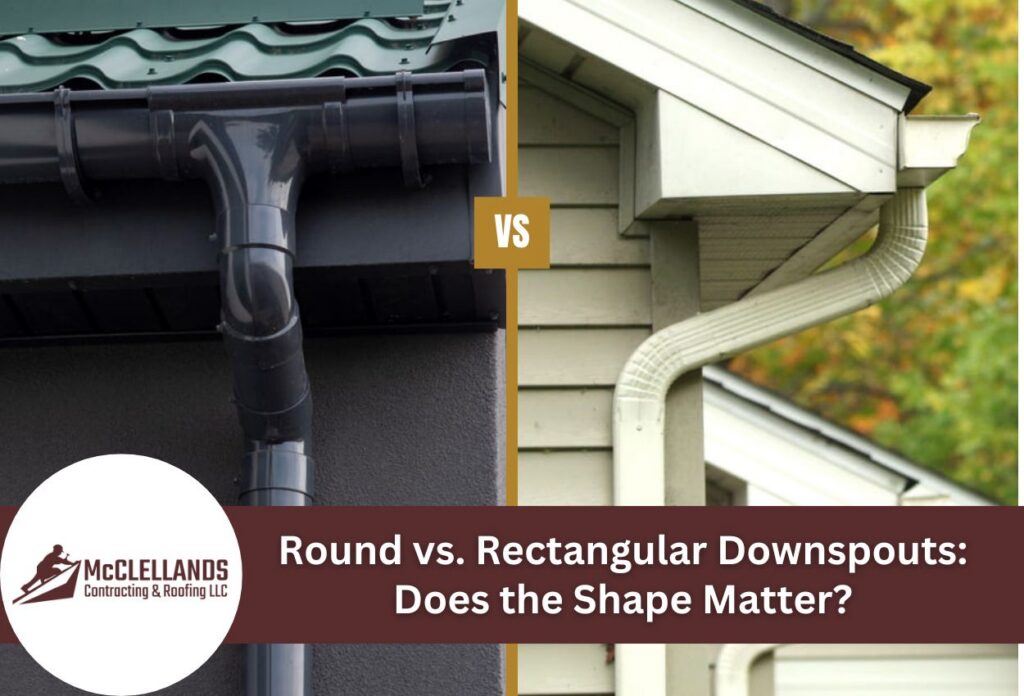

Yes, downspout shape affects drainage capacity; standard 3×4-inch rectangular downspouts handle roughly 70% more water volume than 3-inch round downspouts of the same diameter, though equivalent 4-inch round profiles paired with 5-inch half-round gutters carry marginally more volume than 3×4 rectangular at the same gutter pitch. That difference matters in Pittsburgh, where homes get 37 to 40 inches of rain and snow annually, repeated temperature changes stress gutter systems, and older steeply pitched roofs push concentrated runoff into downspouts fast.
Choosing the wrong shape or size for your roof and lot can lead to overflow, ice buildup, and water against your foundation, problems that show up often on Pittsburgh’s older brick and wood-frame homes with tight side yards and masonry basements.
*Please note, price ranges listed in this article may not reflect the final cost of your project. Prices are subject to change based on various factors such as local labor rates, material quality, and more. All costs established in this article are rough estimates based on average industry rates.
How Do Round and Rectangular Downspouts Compare in Water Flow Capacity?
Round and rectangular downspouts of equivalent gutter pairings carry nearly identical water volume; a 3×4-inch rectangular downspout covers a cross-sectional flow area of 12.0 sq. in. versus 12.6 sq. in. for a 4-inch round, making the round marginally larger but the rectangular the standard fit for 5-inch K-style gutters, which dominate Pittsburgh-area homes. The practical capacity difference between the two is minimal when properly sized.
| Shape | Common Size | Cross-Sectional Flow Area (sq. in.) | Compatible Gutter Size | Recommended Max Roof Drainage Area (sq. ft.) |
|---|---|---|---|---|
| Round | 3-inch | 7.1 | 4-inch half-round | 600 to 700 |
| Round | 4-inch | 12.6 | 5-inch half-round | 1,000 to 1,200 |
| Rectangular | 2×3-inch | 6.0 | 4-inch K-style | 500 to 600 |
| Rectangular | 3×4-inch | 12.0 | 5-inch K-style | 1,100 to 1,200 |
The 3×4-inch rectangular downspout is the residential standard on Pittsburgh-area homes and pairs directly with 5-Inch K-style gutters, the most common gutter type on local houses. Cross-sectional area alone does not tell the whole story, though. Rectangular profiles create more wall friction inside the downspout, which slightly reduces flow speed, but their flat profile sits closer to the fascia boards. That flat fit matters on Pittsburgh properties with tight side yards, where a projecting round downspout can interfere with fences, neighboring structures, or downspout routing along narrow exterior walls.
Which Downspout Shape Handles Clogs and Heavy Rain Better?
Round downspouts resist clogs better than rectangular ones. Debris entering a round profile can spin and flush through more freely, while rectangular corners give leaves, seed pods, and compacted material a place to catch and build up, especially at the elbow transition point where most blockages start. Gutter installers commonly note that round profiles see lower clog frequency at those elbow transitions compared to rectangular downspouts of similar size.
Pittsburgh’s rainfall pattern makes clog resistance more than a minor consideration. The city averages approximately 10 to 12 days per year with rainfall exceeding 1 inch, and peak storm season can push past 2 inches per hour. That 2-inch-per-hour threshold is where a partially blocked downspout begins to overwhelm a 5-inch gutter, pushing water over the edge and toward the foundation, a serious problem on older Pittsburgh homes with masonry basements and poor perimeter drainage.
Temperature changes add another layer to the shape comparison. Pittsburgh sees approximately 75 to 85 freeze-thaw cycles per year between October and April. Rectangular downspouts with seamed corners are more vulnerable to ice expansion stress than seamless round profiles, because ice forming inside a rectangular downspout pushes outward into those rigid corners rather than distributing pressure evenly around a curved wall. Over multiple seasons, that repeated stress can open seam gaps, crack solder points, and accelerate leaks at the joint repairs that add up quickly on older aluminum or galvanized systems that may already have weakened connections.
Round or Square Downspouts: Which One Actually Fits Pittsburgh Homes Better?
For most Pittsburgh rowhouses and older brick homes with less than 4 feet of side clearance, round downspouts are the better fit; they project only 3 to 3.5 inches from the wall, compared to 3.5 to 4.5 inches for rectangular profiles. That inch of difference sounds small, but on a narrow side yard shared with a fence, a neighboring foundation, or a utility run, it matters during installation and routing.
| Shape | Wall Projection | Pros | Cons |
|---|---|---|---|
| Round | 3 to 3.5 inches | Lower profile, traditional appearance, handles temperature changes better, no corner seams to crack | Lower standard capacity, less compatible with high-volume K-style gutters |
| Rectangular | 3.5 to 4.5 inches | Higher flow capacity, standard fit for modern seamless aluminum systems | Projects farther from the wall, corner seams are vulnerable to ice stress |
Pittsburgh’s early 20th-century housing, with brick facades, masonry foundations, and steep pitches, pairs naturally with round aluminum or copper downspouts from both a practical and an appearance standpoint. Round profiles also align with half-round gutter systems that appear on many older homes in the region. Our gutter installation and replacement services cover both round and rectangular profiles for Pittsburgh properties.
If a single downspout drains more than 800 sq. ft. of roof area, move to a 3×4-inch rectangular profile regardless of side yard constraints; the higher capacity outweighs the wall projection difference when runoff volume is the bigger risk. McClellands Contracting and Roofing, LLC can assess your roof drainage area and side yard clearance to recommend the right shape for your specific property.
What Do Round vs. Rectangular Downspouts Cost, and Which Delivers Better Long-Term Value?
Rectangular downspouts cost 15% to 25% more installed than standard round systems of equivalent linear footage, but that gap shrinks considerably when weighed against Pittsburgh-area basement waterproofing repairs that commonly range from $3,000 to $10,000.
| Downspout Type | Material Cost per Linear Foot | Typical Installed Cost per Linear Foot (Pittsburgh) | Estimated Lifespan (Aluminum) | Replacement Frequency Over 30 Years |
|---|---|---|---|---|
| Round aluminum | $1 to $2 | $4 to $7 | 20 to 30 years | 1 to 2 times |
| Rectangular aluminum | $1.50 to $3 | $5 to $9 | 20 to 30 years | 1 to 2 times |
| Copper round | $8 to $15 | $18 to $30 | 50+ years | 0 to 1 time |
Aluminum downspouts of either shape typically carry 20-year manufacturer warranties in standard residential grades, and seamless aluminum systems, the most common type installed in Pittsburgh, are available in both round and rectangular profiles. That makes the material lifespan roughly equivalent between the two shapes when properly maintained. Copper round downspouts carry the highest upfront cost at $18 to $30 per linear foot installed, but their 50+ year lifespan eliminates most replacement cycles over the life of the home, a meaningful advantage on Pittsburgh properties with older masonry foundations where repeated water intrusion from undersized or failing downspouts adds up fast. For homes where undersizing creates overflow risk, the cost difference between round and rectangular aluminum is far smaller than one foundation repair bill.
How Should Pittsburgh Homeowners Decide Which Downspout Shape Is Right for Their Home?
Match your downspout shape to your roof drainage area first. If any single downspout drains more than 800 sq. ft. of roof area, use a 3×4-inch rectangular or 4-inch round profile at a minimum. Work through these five checks before choosing a shape.
- Measure your roof drainage area per downspout. If that area exceeds 800 sq. ft., a 2×3-inch rectangular downspout rated for 500 to 600 sq. ft. will not keep up. Step up to a 3×4-inch rectangular or 4-inch round, both rated for 1,100 to 1,200 sq. ft. Shape affects drainage efficiency most when a system is undersized or when routing requires tight elbow turns; a properly sized, well-maintained system of either shape performs comparably under normal rainfall.
- Check your side yard clearance. If clearance is under 4 feet, round profiles project only 3 to 3.5 inches from the wall, roughly 0.5 to 1 inch less than rectangular profiles. That difference matters when routing along fences, neighboring foundations, or utility runs.
- Match the downspout to your gutter profile. K-style gutters pair best with rectangular downspouts. Half-round gutters, common on Pittsburgh’s older brick and early 20th-century homes, pair best with round downspouts.
- Assess north-facing or shaded wall exposure. On walls that see 80 or more freeze-thaw cycles per season, seamless round profiles reduce ice-stress cracking risk because curved walls distribute internal ice pressure evenly, while rectangular corner seams do not. Proper soffit and fascia board condition also plays a role in how well downspout connections hold up through repeated freeze-thaw stress.
- Check foundation discharge distance. If a downspout discharges within 6 feet of the foundation, pair either shape with a minimum 4-foot extension or a splash block. This applies regardless of shape and is a common gap on Pittsburgh properties with masonry basements.
Shape is a secondary factor when systems are properly sized and maintained, but sizing errors or tight routing make shape choice far more consequential. Also note that Pittsburgh-area municipalities may require permits when downspout connections tie into underground stormwater systems or when regrading is involved.
Ready to Choose the Right Downspout for Your Pittsburgh Home?
Getting the wrong shape or size wrong can mean overflow, foundation wetting, and basement repairs that run $3,000 to $10,000 far more than the cost of getting it right the first time. Matching your downspout to your actual roof drainage area, gutter profile, and side yard clearance takes a site-specific look, not a general guess.
McClellands Contracting and Roofing, LLC works with Pittsburgh homeowners to assess roof drainage area, wall clearance, and discharge location against the region’s 37 to 40 inches of annual precipitation. A professional roof inspection can identify drainage vulnerabilities before they become expensive repairs. The right downspout, properly sized and routed, is the last line of defense between your roof runoff and your foundation.
Not ready to schedule? Learn more about downspout selection and installation.