

 Residential
 Commercial
 Interior
 Exteriors
 Service Areas
 Contact Us
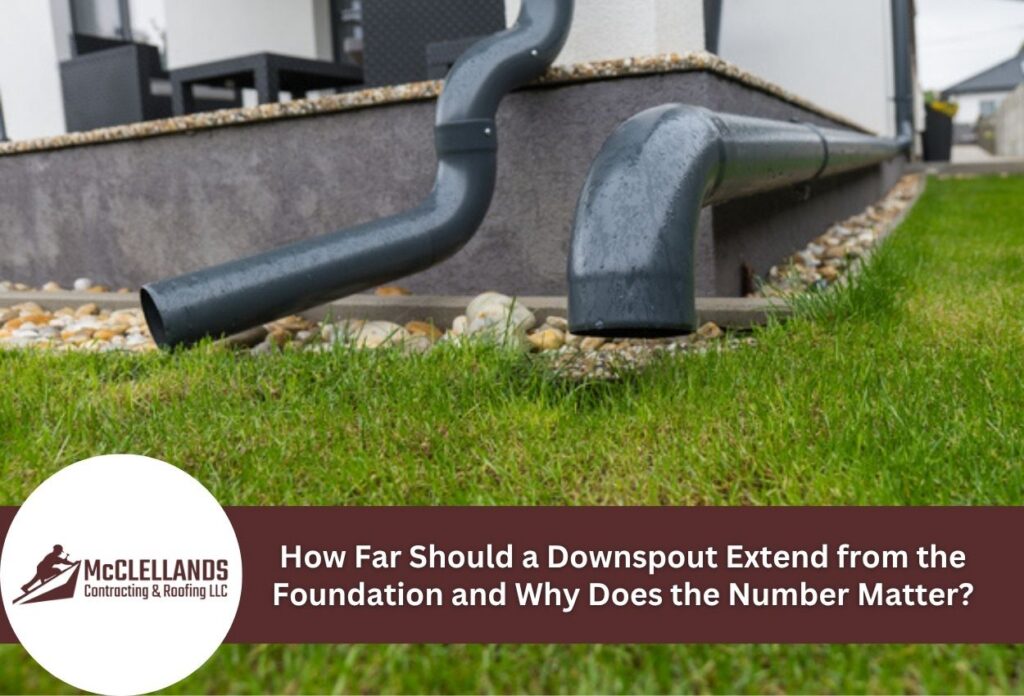

A downspout should extend at least 4 to 6 feet from the foundation, with the International Residential Code referencing a 5-foot minimum and many Pennsylvania municipalities enforcing a 4- to 5-foot floor. That range is not a suggestion. It’s a measured threshold based on how far water travels through soil before it can pool against a structure.
In Pittsburgh and Allegheny County, that number carries extra weight. Clay-heavy soils common across western Pennsylvania absorb water slowly and hold it longer than sandy or loamy ground. Older masonry foundations the kind found throughout prewar neighborhoods in and around Oakdale and Pittsburgh are especially vulnerable because mortar and aging block absorb moisture differently than poured concrete in newer builds. Add in the region’s recurring temperature changes and wet winters, and a short downspout becomes a direct path to basement seepage and foundation damage.
What Is the Minimum Distance a Downspout Should Drain from the House to Protect the Foundation?
A 4-foot discharge may satisfy local code, but 6 to 10 feet is the functional target for keeping water away from your foundation, and on clay-heavy or compacted lots, even that may not be enough.
| Source | Baseline Discharge Distance | Clay Soil Adjustment | Effective Target Range |
|---|---|---|---|
| International Residential Code | 5 feet minimum | Add 3 to 5 feet | 8 to 10 feet |
| General Industry Best Practice | 6 to 10 feet | Add 2 to 4 feet | 8 to 14 feet |
| Pennsylvania / Local Code Guidance | 4 to 5 feet minimum | Add 2 to 4 feet | 6 to 9 feet |
Meeting the 4- to 5-foot Pennsylvania minimum keeps an inspector satisfied, but it does not protect a basement on a flat or negatively graded lot; water discharged that close can circle back toward the foundation in under an hour on compacted ground. The 6- to 10-foot range is where real basement protection begins, and clay soils common across western Pennsylvania push that target higher.
Homes in Pittsburgh’s hill neighborhoods or on sloped lots face an added problem: surface water recirculates toward the structure on packed or clay-heavy terrain, making buried lateral drain lines with pop-up emitters a more reliable solution than surface extensions alone.
What Happens to Your Foundation When a Downspout Drains Too Close?
A single downspout serving a 1,500 square foot roof section can discharge 900+ gallons during a 1-inch rainfall, and if that water lands within 3 feet of your foundation, the soil there can absorb 1 to 2 inches of that runoff before it has anywhere left to go. That means saturated ground pressing directly against your basement walls.
The failure sequence is predictable. Saturated soil builds hydrostatic pressure, the weight and force of waterlogged ground pushing inward against your foundation walls. In masonry and older poured-concrete foundations, which are common throughout western Pennsylvania and Pittsburgh’s prewar neighborhoods, that pressure works its way through mortar joints and hairline gaps. The early signs are efflorescence, white mineral staining on basement walls, followed by seepage, then cracking. Most contractors report this damage pattern appearing within 3 to 10 years of chronic short-discharge drainage, often after the homeowner has already forgotten when the problem started.
Winter makes this worse. Water that pools within 2 feet of the foundation in late fall freezes as temperatures drop. Ice expands by about 9%, and that expansion pushes laterally against foundation walls, a cycle that repeats from roughly November through March across Allegheny County. Each freeze-and-thaw cycle widens existing cracks slightly. Over several winters, what started as a slow seep becomes a structural problem that no amount of waterproofing paint will fix from the inside.
Which Downspout Extension Method Is Right for Your Home and Yard?
Buried PVC lateral lines discharge water 10 to 30+ feet from the foundation and outperform every other extension method on distance, making them the top choice for Pittsburgh’s narrow urban lots and steeply graded properties where surface extensions simply run out of room. Proper gutter and downspout drainage service ensures these systems are correctly connected and functioning from the roofline down.
| Extension Method | Discharge Distance | Installed Cost Range | Lifespan | Best-Fit Scenario |
|---|---|---|---|---|
| Splash Block | 1 to 3 feet | $10 to $40 | 10 to 20+ years | Sloped lot with good drainage |
| Rigid Aluminum/Vinyl Extension | 4 to 8 feet | $15 to $60 | 10 to 20+ years | Flat or gently sloped lot with open ground |
| Corrugated Flexible Extension | 4 to 8 feet | $5 to $15 | 3 to 7 years | Temporary fix or tight budget; not recommended long-term |
| Buried PVC Lateral Line with Pop-Up Emitter | 10 to 30+ feet | $800 to $2,000+ | 50 years | Narrow urban lots, steeply graded or clay-heavy yards |
| Roll-Out/Hinged Extension | 4 to 6 feet | $20 to $50 | 5 to 10 years | Small side yards where clearance is limited |
Corrugated flexible pipe costs the least upfront at $5 to $15, but western Pennsylvania’s repeated temperature changes shorten its lifespan to just 3 to 7 years, far below the 10 to 20+ years you get from rigid aluminum, vinyl, or PVC options. Replacing it every few years erases any savings fast. For lots where a surface extension cannot achieve the 6- to 10-foot discharge target, a buried PVC lateral line is the most dependable long-term solution, especially on the clay-heavy, compacted ground common across Allegheny County and Pittsburgh’s hill neighborhoods.
How Do You Know If Your Current Downspout Extension Is Long Enough?
Measure from the foundation face to where the water actually exits. If that distance is under 6 feet, the extension is inadequate regardless of how the yard slopes; under 4 feet is a code-level concern in most Pennsylvania jurisdictions.
Run through this 5-point checklist after the next rainfall to know where you stand:
- Discharge distance is 6 feet or more: Measure with a tape measure from the foundation face to the discharge point. Anything under 6 feet fails this threshold, even if the yard appears to drain well.
- No pooling within 10 feet of the foundation 24 hours after a 1-inch rain pass: Walk the perimeter the day after a moderate storm. Standing water that lingers more than 24 hours points to a drainage problem at the surface or soil level.
- Grade slopes away from the home at a minimum of 6 inches over the first 10 feet: A level and tape measure can confirm this. A flat or negative grade directs discharged water straight back toward the foundation.
- No efflorescence or moisture staining on basement walls pass: White mineral deposits or dark water staining on basement walls are early warning signs that water is already pressing against the foundation.
- Discharge point is not within 3 feet of a neighbor’s lot line or a municipal drain pass: Discharging too close to a property line or storm drain inlet can violate local ordinances and shift drainage problems onto adjacent properties.
Failing 2 or more items on this checklist indicates active drainage risk that warrants professional evaluation or extension installation before the next wet season. In the Pittsburgh area, the highest-risk windows are spring (March to May) and fall (September to November), both of which bring heavy rainfall totals that overwhelm short or poorly graded extensions fast. Address any failures before those windows open. A residential roof inspection can also identify whether drainage issues originate at the roofline before water ever reaches the downspout.
How Much Does It Cost to Extend a Downspout and What Does It Save?
An $800 to $2,000 fix now can prevent a repair bill that is 10 to 30 times larger, and the table below shows exactly what that math looks like across three common extension scenarios.
| Extension Type | Upfront Cost | Repair Cost It Can Prevent |
|---|---|---|
| Surface extension with splash block | $20 to $75 DIY / $100 to $200 installed | $3,000 to $8,000 (foundation crack repair) |
| Buried PVC lateral line with pop-up emitter | $800 to $2,000+ installed | $5,000 to $15,000 (basement waterproofing system) |
| Professional regrading plus extension | $500 to $1,500 | $10,000 to $25,000 (full exterior foundation waterproofing) |
The gap between those two columns is the real story. Foundation damage also reduces home resale value by $10,000 to $30,000 in competitive markets if it must be disclosed, so the financial risk goes well beyond just the repair bill itself.
One more factor makes this decision straightforward: homeowners insurance typically does not cover foundation damage caused by poor drainage or gradual leaks. That means every dollar of repair cost comes directly out of pocket. An extension is a self-funded protection decision with a measurable payback, and the numbers make the case on their own. If a checklist inspection reveals drainage gaps, addressing them before the next wet season is the lowest-cost path available.
McClellands also offers financing options to help homeowners manage the upfront cost of drainage repairs and extensions.
Ready to Fix Your Downspout Drainage? Here’s How McClellands Can Help.
Stopping foundation damage before it becomes a $10,000 to $30,000 problem starts with one straightforward step: getting a professional eye on your downspouts before spring rains arrive. McClellands Contracting and Roofing, LLC serves Pittsburgh, Allegheny County, and surrounding western Pennsylvania communities, and the team understands the clay-heavy soils, older masonry foundations, and temperature-driven drainage challenges that make this region harder to drain than most.
Schedule your drainage inspection
Not ready to schedule? Learn more about downspout extension and drainage service.