


 Residential
 Commercial
 Interior
 Exteriors
 Service Areas
 Contact Us
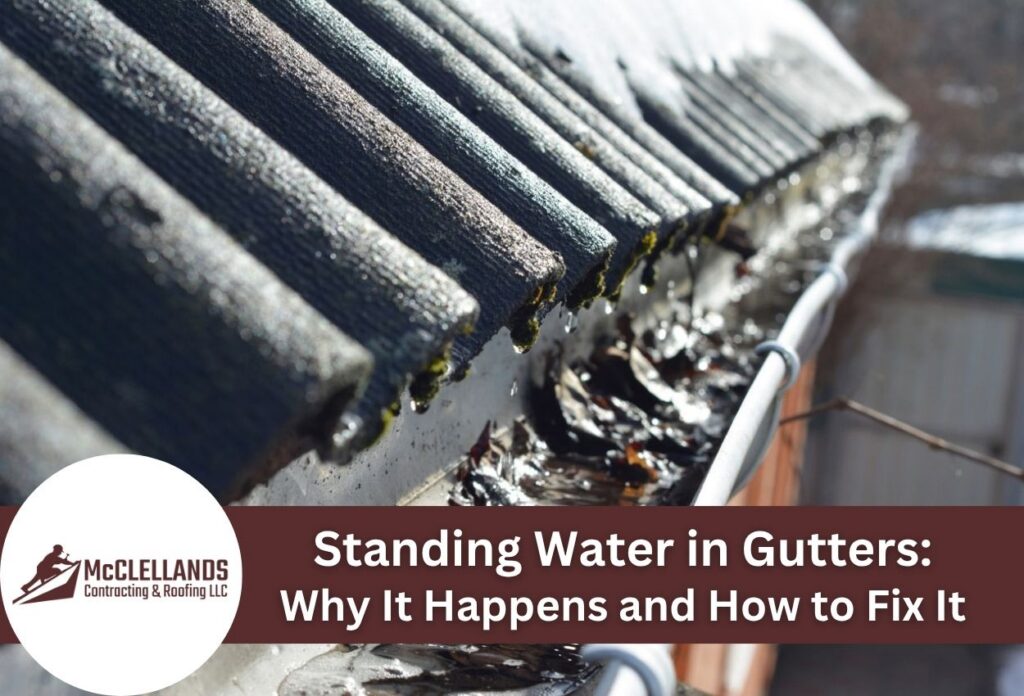

Standing water in gutters almost always comes down to one of three problems: a clog, an incorrect slope, or a sagging gutter run. Pittsburgh-area homes deal with this year-round, thanks to 35 to 40 inches of annual precipitation plus repeated temperature changes that pack gutters with ice, debris, and compacted leaves before homeowners realize there is a problem.
The window to act is short. Water sitting in gutters for more than 24 to 48 hours can start rotting fascia boards, wicking into soffit material, and pushing moisture toward foundation areas below. Homes built before 1960, which make up a large share of Allegheny County’s housing, often have wood fascia that is already weathered, making it far more vulnerable to water damage than newer construction.
Why Is Water Sitting in Your Gutters and Not Draining?
Standing water almost always traces back to one of four problems, and identifying the right one before you start fixes saves time, money, and repeat repairs.
- Clogged downspout: A single blocked 2×3-inch or 3×4-inch downspout can back up 20 to 30 linear feet of gutter. Leaves, seed pods, and shingle grit are the most common culprits in Pittsburgh-area neighborhoods where mature tree cover lines most streets.
- Incorrect pitch: Gutters need to slope at least 1/4 inch per 10 feet toward the downspout. Even a small deviation flattens flow and lets water pool in place, especially after heavy rain that is common in western Pennsylvania.
- Sagging gutter run: Hanger spacing beyond 24 to 36 inches allows sections to bow under the combined weight of water and debris. A sag of just 2 inches across a 20-foot run is enough to reverse slope and trap standing water, meaning a clog fix alone will not solve the problem.
- Undersized gutters: Standard 5-inch K-style gutters safely handle roughly 5,520 square feet of roof drainage. Smaller profiles fall short on steep-slope or multi-valley rooflines common across Pittsburgh’s older housing and newer suburban developments alike.
Two of these causes get worse with local conditions. Leaf accumulation peaks in October through November in tree-dense suburban corridors, and temperature changes between roughly 25 degrees and 40 degrees Fahrenheit in winter can turn pooled water into ice that locks debris in place and adds nearly 60 lbs per cubic foot of weight stress on hangers. Pinpointing the actual cause first is what separates a lasting fix from a temporary patch.
How Do You Unclog Gutters With Standing Water Yourself?
Start by checking whether the downspout outlet is blocked: that single point causes the majority of standing water problems and is the fastest fix. A pressure nozzle running at 40 to 60 PSI is typically enough to break up soft debris. Before picking a clearing method, compare your options:
| Method | Approximate Cost | Best For | Limitations |
|---|---|---|---|
| Garden hose flushing | $0 additional cost | Soft clogs up to 10 feet | Cannot break up compacted debris or reach deep blockages |
| Plumber’s snake | $25 to $50 rental | Compacted debris 10 to 30 feet deep | Requires some physical effort: can scratch aluminum gutters |
| Wet/dry shop vacuum | $0 to $15 if owned | Dry leaf debris only | Ineffective on wet, matted clogs or downspout blockages |
Once you have chosen your method, follow these steps in order:
- Confirm the problem is a clog, not a slope issue, by checking whether the downspout outlet is visibly blocked or releases water when poked with a stick.
- Clear the downspout first using a garden hose at 40 to 60 PSI or a plumber’s snake for deeper blockages.
- Flush the gutter run from the high end toward the downspout to push any remaining debris out.
- Run water for 2 to 3 minutes and watch for pooling: drainage should move steadily with no standing water remaining.
Any roofline above 12 to 15 feet or a roof pitch steeper than 6:12 carries a real fall risk that most homeowners should not take on alone. Pittsburgh’s humid conditions make ladder feet and roof edges slippery, especially in spring and fall when gutter work is most needed. If the roofline or pitch puts you in that range, McClellands Contracting and Roofing, LLC offers professional gutter clearing and repair services without the safety trade-off.
How Do You Adjust Gutter Slope to Fix a Standing Water Problem?
The correct slope standard is 1/4 inch of drop per 10 linear feet toward the downspout, meaning a 40-foot gutter run should fall exactly 1 inch total from the high end to the outlet. That sounds small, but even a half-inch error across that same run is enough to reverse flow and trap standing water in place.
The adjustment process starts with marking the correct drop point. Use a chalk line or string level to map where the gutter should sit at each end, then work along the run section by section. Loosen the gutter hangers, typically spaced every 24 to 36 inches, and re-hang each one at the corrected height before re-securing. Aluminum K-style gutters, the most common type in the Pittsburgh market, can be re-pitched without full replacement as long as the hangers are still intact and the fascia board behind them is structurally sound.
When Re-Pitching Is Not Enough
Slope adjustment alone has real limits. If a gutter shows more than 1/2 inch of visible sag per 10-foot span, the hangers have likely pulled away from the fascia boards far enough that re-pitching will not hold long-term. Fascia boards that show rot, soft spots, or delamination are a more serious sign that a re-pitched gutter anchored to damaged fascia boards will sag again within one season, and partial or full gutter replacement becomes the appropriate fix rather than a hanger adjustment. Both conditions are worth checking before putting any time into a slope correction that will not last.
What Damage Can Standing Water in Gutters Cause to Fascia Boards and Your Home?
Standing water in gutters damages four distinct parts of a home: fascia boards, soffit material, foundation areas, and interior walls, and repair costs range from $300 to well over $10,000 depending on how long the water was left to sit.
| Damage Type | Cause | Typical Onset Timeline | Average Repair Cost Range |
|---|---|---|---|
| Fascia Board Rot | Chronic overflow contact against wooden fascia boards | Visible damage in 1 to 3 seasons | $300 to $800 per 20-foot section |
| Soffit Deterioration | Moisture wicking from saturated fascia boards into soffit panels | 1 to 2 seasons after fascia board damage begins | $400 to $900 per affected section |
| Foundation Seepage | Overflow discharge pooling near foundation footing | 2 to 5 years of standing water | $2,000 to $10,000+ depending on severity |
| Interior Mold/Moisture | Water tracking behind fascia boards into wall cavities | 1 to 3 seasons of uncorrected overflow | $500 to $4,000+ depending on spread |
Pittsburgh’s temperature changes from November through March add serious pressure to that timeline. Water that seeps behind a gutter and contacts wooden fascia boards will expand as it freezes, forcing the wood grain apart. That process compresses what would normally be a 3-season damage window down to a single winter, especially on homes with the weathered wooden fascia boards common across older Allegheny County neighborhoods.
Gutters holding standing water for more than 48 hours after a rainstorm should be inspected within 7 days to check whether overflow is making direct contact with the fascia board. Catching that contact point early is the difference between an $800 soffit and fascia board repair and a much larger structural problem that works its way into the soffit, wall cavity, or foundation over time.
Is It Worth Fixing Standing Water in Gutters Yourself, or Should You Hire a Pro?
For simple clog clearing, DIY is a reasonable option, but for slope correction, fascia board replacement, or full gutter replacement, professional service delivers a measurably better return on every dollar spent.
| Scenario | DIY Cost Range | Pro Cost Range | Time Required | Risk Level |
|---|---|---|---|---|
| Clog clearing | $0 to $50 | $100 to $250 | 1 to 2 hours | Low |
| Slope adjustment | $20 to $80 in materials | $150 to $400 | 2 to 4 hours | Moderate errors cause repeat sagging |
| Fascia board replacement | $100 to $300 in materials | $300 to $800 per 20-foot section | 3 to 6 hours | High structural attachment points at risk |
| Full gutter replacement | Not recommended | $1,000 to $2,500 (typical single-story home) | 4 to 8 hours | High risk if DIY attempted |
The ROI case for professional slope correction is hard to argue with. A $150 to $400 re-pitch job on a sagging gutter run can prevent $300 to $800 in fascia board replacement and potentially thousands in foundation repair, making it one of the highest-return maintenance investments in exterior home care. Spending $400 now to avoid $10,000+ in foundation damage later is not a close call.
Pennsylvania also requires home improvement contractors to be registered with the PA Attorney General’s Office, so homeowners should verify contractor registration before hiring anyone for paid exterior repair work. McClellands Contracting and Roofing, LLC meets that standard and can handle slope correction, residential roof inspection, fascia board work, and full replacements in a single visit.
Ready to Stop the Damage? Get Your Gutters Fixed Before the Next Rain or Freeze Hits.
Standing water left in gutters for more than 48 hours can start working against your fascia boards, soffit, and foundation, and repair costs climb fast once that contact point takes hold. Pittsburgh and western Pennsylvania homeowners don’t get long windows between rainstorms and temperature drops, which means a gutter problem that seems minor today can turn into a $2,000 to $10,000+ foundation issue by spring.
McClellands Contracting and Roofing, LLC serves Allegheny, Beaver, Butler, and Washington County homeowners with gutter inspections, slope corrections, fascia board repairs, and full replacements. One inspection can tell you whether a $150 to $400 fix is all that stands between you and a much larger repair bill.
Schedule your gutter inspection.
Not ready to schedule? Learn more about gutter repair and replacement services.