

 Residential
 Commercial
 Interior
 Exteriors
 Service Areas
 Contact Us
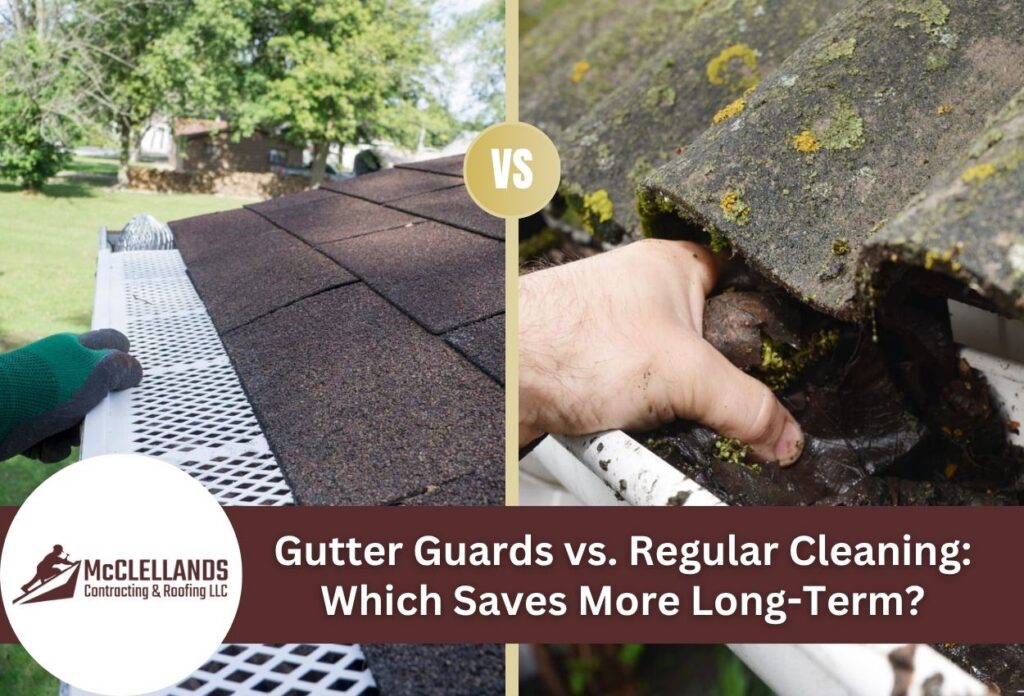

Most Pittsburgh homeowners with heavy tree cover break even on gutter guard installation within 3 to 5 years compared to paying for professional cleaning twice a year at $150 to $250 per visit. That math shifts depending on how many trees hang over the roofline, how tall the home is, and what type of guard gets installed, but the 3-to-5-year window is a reasonable starting point for most properties in the area.
Pittsburgh’s conditions make this decision harder than it looks. The city gets 37 to 39 inches of rain annually, 40 to 45 inches of snowfall, and sits under one of the densest deciduous tree canopies in western Pennsylvania. That combination pushes leaves, seed pods, twigs, and shingle grit into gutters faster than most other climates.
*Please note, price ranges listed in this article may not reflect the final cost of your project. Prices are subject to change based on various factors such as local labor rates, material quality, and more. All costs established in this article are rough estimates based on average industry rates.
How Much Does Regular Gutter Cleaning Cost Without Gutter Guards in Pittsburgh?
Homeowners who skip gutter guards and clean twice a year spend $300 to $500 annually on average, with 10-year totals climbing past $5,000 for 2-story homes cleaned 3 times per year.
| Cleaning Frequency | Single-Story Cost Per Visit | Two-Story Cost Per Visit | 5-Year Total (Single-Story) | 5-Year Total (Two-Story) | 10-Year Total (Single-Story) | 10-Year Total (Two-Story) |
|---|---|---|---|---|---|---|
| 1x per year | $150 to $250 | $200 to $350 | $750 to $1,250 | $1,000 to $1,750 | $1,500 to $2,500 | $2,000 to $3,500 |
| 2x per year | $150 to $250 | $200 to $350 | $1,500 to $2,500 | $2,000 to $3,500 | $3,000 to $5,000 | $4,000 to $7,000 |
| 3x per year | $150 to $250 | $200 to $350 | $2,250 to $3,750 | $3,000 to $5,250 | $4,500 to $7,500 | $6,000 to $10,500 |
For most Pittsburgh homes without gutter guards, two cleanings per year are the minimum: one in late spring after pollen and seed pod drop, one in late fall after peak leaf drop. Homes with mature oaks, maples, or overhanging evergreens should add a third visit. Homes with buried downspout extensions or older drainage systems common in Pittsburgh’s pre-war housing may face additional flushing or snaking costs of $75 to $150 per service visit, which can push annual totals well above the base cleaning costs shown here. Those extra charges add up fast over a decade.
What Does Gutter Guard Installation Actually Cost, and Do Gutter Guards Eliminate Gutter Cleaning Completely?
No gutter guard type eliminates cleaning. Even professional micro-mesh systems, which reduce maintenance by 80% to 90%, still require inspection and light cleaning once every 1 to 2 years to clear shingle grit, seed pods, and roof debris that builds up on the guard surface.
| Guard Type | Installed Cost per Linear Foot | Maintenance Reduction | Typical Lifespan |
|---|---|---|---|
| Foam insert | $0.50 to $2.00 | 20% to 40% | 3 to 5 years |
| Brush insert | $0.50 to $2.00 | 20% to 40% | 3 to 5 years |
| Reverse curve | $1.50 to $4.00 | 50% to 70% | 10 to 20 years |
| Professional micro-mesh | $7.00 to $12.00 | 80% to 90% | 10 to 20 years |
Foam and brush inserts cost the least upfront but wear out in 3 to 5 years and offer only modest maintenance reduction, making them a poor long-term value for Pittsburgh homes with heavy tree cover. Reverse curve guards perform better but carry a real risk on north-facing or shaded roof sections: Pittsburgh winters bring temperatures that cross 32 degrees Fahrenheit repeatedly, and debris trapped on reverse curve or foam guard surfaces can freeze and contribute to ice damming.
Professional micro-mesh is the only style that consistently delivers 80% to 90% maintenance reduction without trapping debris in ways that make winter drainage problems worse, though even that system still needs a light check once every 1 to 2 years.
Which Gutter Guard Types Hold Up Best Under Pittsburgh’s Weather Conditions?
Stainless steel micro-mesh guards are the best-performing option for Pittsburgh homes, and the reasons are specific to this region’s conditions. Pittsburgh gets 37 to 39 inches of rain annually and sits under a dense deciduous canopy that drops maple helicopters, oak tassels, and seed pods directly into gutters. Micro-mesh openings are fine enough to block all of that debris, including shingle grit that washes off during heavy rain. The stainless steel mesh also resists corrosion in Pittsburgh’s high-humidity summers, where dew points regularly sit in the 60s. Foam and brush inserts, by contrast, absorb moisture and degrade under repeated temperature changes, often failing within their 3-to-5-year lifespan well before that point on Pittsburgh’s more exposed rooflines.
Aluminum reverse curve guards sit in the middle of the performance range. They work adequately on homes with moderate leafall, but Pittsburgh gets several intense thunderstorms each year, enough that rainfall can sheet across a reverse curve guard entirely and overshoot the gutter below. That is a real drainage failure, not just reduced performance.
Pittsburgh’s older neighborhoods and hillside properties add one more variable. Steep roof pitches are common throughout the city, and steeper slopes push water off the surface of the roof faster than low-slope roofs do. That higher water velocity changes how well any guard style performs and how the guard must be angled during installation. Homeowners should raise this point directly when getting installation quotes, since the correct angle matters more on a steep roof than on a flat one.
Is Gutter Guard Installation Worth the Cost Compared to Annual Cleaning Over 10 Years?
Yes, on a 150-linear-foot gutter system, professional micro-mesh guards save roughly $1,500 over 10 years compared to cleaning twice per year without guards, a savings of about 37%. The math is straightforward once the numbers are laid out side by side.
| Scenario | Upfront Cost | Ongoing Maintenance Cost | 10-Year Total |
|---|---|---|---|
| No guards cleaning 2x per year at $200 per visit | $0 | $400 per year ($4,000 over 10 years) | $4,000 |
| Micro-mesh installed at $10 per linear foot on 150 linear feet + 1x annual light cleaning at $100 per visit | $1,500 | $100 per year ($1,000 over 10 years) | $2,500 |
The break-even point lands at about 3.75 years. At $1,500 installed, the system avoids two $200 cleaning visits per year, $400 in annual savings, meaning the upfront cost is recovered in under 4 years. Homes with 3-story access challenges or heavier debris often pay more per cleaning visit, which pushes that break-even point even earlier.
There is one counterargument worth knowing. Homes with extremely heavy debris, dense oak canopies, nearby pine trees, or high shingle grit runoff may still need annual professional cleaning even after micro-mesh is installed. In those cases, the maintenance savings assumption shrinks, and the 37% ROI advantage can narrow or disappear entirely within the 10-year window. Before committing to guards, homeowners should honestly assess how often gutters are currently clogging and whether one cleaning per year is realistic post-installation or wishful thinking.
Should You Install Gutter Guards or Stick With Regular Cleaning? A Decision Guide for Pittsburgh Homeowners
Gutter guards are likely worth the investment if 3 or more of the following conditions apply to your home; if fewer than 3 match, regular cleaning is probably the smarter choice right now.
- Multiple mature deciduous trees within 30 feet of the roofline: Maples, oaks, and other common Pittsburgh-area trees drop leaves, seed pods, and twigs directly into gutters. The more trees, the faster debris builds up and the more cleanings a year the gutters will need.
- Gutters currently require cleaning 2 or more times per year: If 2 annual visits are already the minimum to keep water flowing, guard installation starts paying for itself within a few years.
- The home is 2 stories or taller: Ladder access on taller homes costs more per visit, $200 to $350 per cleaning at the 2-story rate, and raises the safety risk for any DIY attempt.
- The homeowner plans to stay at least 5 years: The break-even point on professional micro-mesh lands at under 4 years. A shorter ownership horizon shrinks or eliminates the financial benefit.
- The existing gutter system is in sound condition: Installing guards on gutters that need replacement within 3 to 5 years turns the installation cost into a sunk cost.
When Regular Cleaning Is the Better Call
- Few nearby trees and one cleaning per year is enough: If gutters clear out adequately with a single annual visit, the payback math on guards does not hold up as well.
- The gutter system is aging and likely needs full replacement within 3 to 5 years: Putting guards on gutters that will need to be pulled out and replaced shortly after is a poor use of money.
- Full downspout flushing matters to you: Guards cannot intercept every type of debris. Shingle grit and fine sediment still reach downspouts, and homeowners who want those lines fully flushed each visit are better served by professional cleaning on a set schedule.
The best windows to schedule either guard installation or a cleaning evaluation in Pittsburgh are April through May after winter debris settles and before the heavy rain season and September through October, before leaf drop peaks and before temperatures drop enough to cause freeze-up. Waiting until gutters are already blocked or ice has formed reduces available options and increases the risk of overflow damage to fascia boards, soffits, and foundations.
Ready to Stop Paying for Repeated Gutter Cleaning? Here’s Your Next Step.
Scheduling a gutter assessment before fall leaf drop hits or before the first hard freeze protects your home through Pittsburgh’s most damaging clog season and avoids the higher costs that come with peak-season demand. McClellands Contracting and Roofing, LLC offers free assessments that cover your current gutter condition, nearby tree coverage, and a written comparison of guard installation costs versus your projected 5-year cleaning costs specific to your home. If your roof or residential roof inspection is also overdue, our team can evaluate both during the same visit.
Get your free gutter assessment.
Not ready to schedule? Learn more about gutter installations.