

 Residential
 Commercial
 Interior
 Exteriors
 Service Areas
 Contact Us
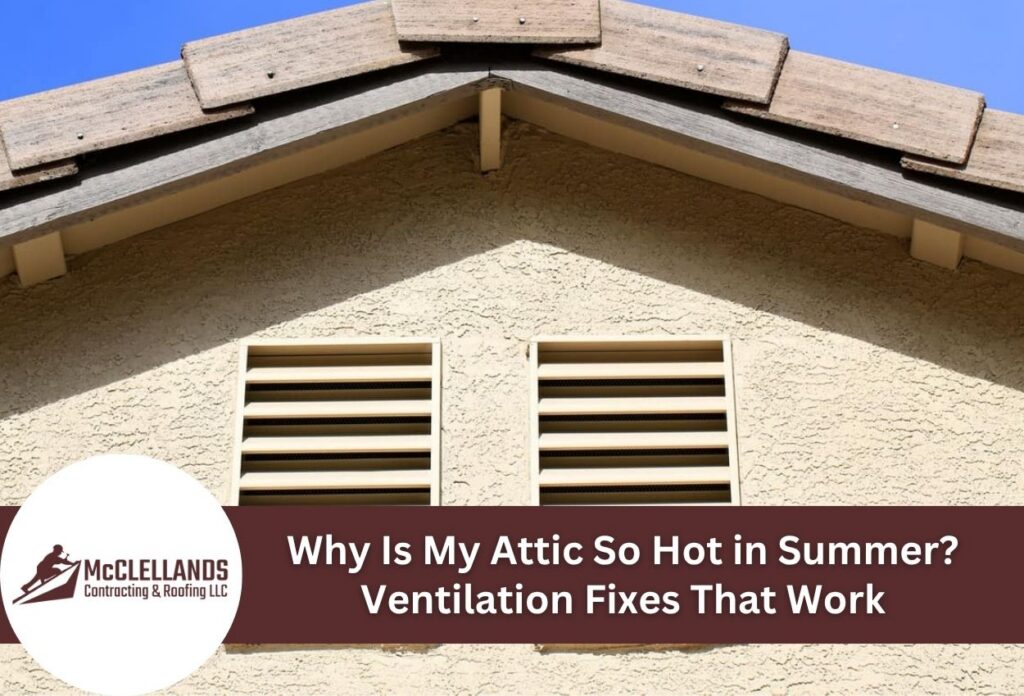

Pittsburgh attics routinely reach 140 degrees to 160 degrees Fahrenheit on summer days when outdoor temperatures sit at just 85 degrees to 90 degrees, and that 50 degrees to 70 degrees gap between outside air and attic air is the real problem, not the heat outdoors. Solar energy pounds your roof surface all day, and without a way to escape, that heat builds up fast inside the attic space.
Pittsburgh’s summer humidity makes this worse. When relative humidity runs between 60% and 70%, trapped heat feels heavier and lingers longer than it would in a drier climate at the same temperature. Moisture stays in the wood, insulation loses efficiency, and your cooling system works harder to keep up.
*Please note, price ranges listed in this article may not reflect the final cost of your project. Prices are subject to change based on various factors such as local labor rates, material quality, and more. All costs established in this article are rough estimates based on average industry rates.
What Causes Hot Air to Get Trapped in Your Attic?
Asphalt shingle roofs, the dominant material on Pittsburgh’s 1900 to 1950 wood-frame housing, transfer 70% to 90% of absorbed solar radiation directly into the attic air space, making the roof surface itself the primary driver of attic overheating. That heat has nowhere to go in a poorly ventilated attic, and it adds up fast throughout the day.
Natural ventilation can’t keep up in summer. Winter attics in this region move air at roughly 4 ACH (air changes per hour) through buoyancy-driven flow; warm interior air rises and escapes. But in summer, that same buoyancy effect weakens because attic air and outdoor air reach similar temperatures. Air exchange drops to about 1.5 ACH, meaning the attic cycles through far less fresh air precisely when heat buildup is at its worst. Opening a window doesn’t fix a physics problem.
Attic ductwork makes the situation worse for a large share of Pittsburgh homeowners. When attic temperatures push past 130 degrees, ductwork running through that unconditioned space can raise cooling loads by 20 to 30%, sending energy bills higher even when the rest of the house appears well insulated. Older Pittsburgh homes were rarely designed with this in mind; ducts were added later and routed wherever space allowed, often through the hottest part of the house. High summer humidity levels between 60% and 70% add another layer, slowing heat dissipation and keeping moisture trapped in attic wood and insulation long after the sun goes down.
What Are the Signs of Poor Attic Ventilation in Summer Heat?
Upper-floor rooms running 5 to 8 degrees warmer than lower floors is one of the clearest signs that attic heat is bleeding through the ceiling into your living space. Several other warning signs point to the same root cause, and most are measurable.
- Upper floors feel noticeably hotter: A temperature gap of 5 to 8 degrees between your top floor and ground floor during summer is a direct signal that heat is not escaping the attic fast enough.
- Energy bills spike in summer: A 15% to 25% jump in cooling costs during the summer without a change in habits or thermostat settings often traces back to attic heat stressing your HVAC system.
- Shingle granule loss accelerates: When trapped heat cycles from underneath the roof deck, it stresses shingles from below while the sun hits from above. This double-sided heat cycling speeds up granule loss faster than normal weathering alone.
- Ice dams form in winter: Pittsburgh averages 30 to 40 inches of snow annually. Ice dams along the roofline in winter are a diagnostic sign of the same ventilation deficit causing summer overheating; warm attic air melts snow unevenly, and it refreezes at the cold eaves.
- Visible daylight gaps or missing soffit screens: Common in Pittsburgh’s older housing, these gaps let pests in and disrupt balanced airflow. Even a 10% reduction in net free area measurably degrades ventilation performance across the entire intake-to-exhaust system, and damaged or missing soffit and fascia boards are a primary cause of those gaps.
- Moisture stains or soft wood in the attic: Humidity levels between 60% and 70% in Pittsburgh summers allow moisture to accumulate in a poorly ventilated attic, leaving stains on rafters and reducing insulation effectiveness over time.
Most of these warning signs share one root cause: the attic is not moving enough air to match the heat stress Pittsburgh summers place on it. If two or more of these signs are present, a ventilation inspection should be the next step.
Which Attic Vents Actually Reduce Summer Heat and How Do They Compare?
Ridge vents paired with continuous soffit vents deliver the greatest consistent attic temperature reduction up to 20 to 30 degrees and remain the industry-recommended baseline when net free area meets the 1:150 ventilation ratio required under Pennsylvania’s Uniform Construction Code. The table below compares five common vent types across the metrics that matter most to Pittsburgh homeowners making a ventilation decision.
| Vent Type | Typical Attic Temp Reduction ( degrees) | NFA or CFM Rating | Average Installed Cost | Best-Fit Condition |
|---|---|---|---|---|
| Ridge Vents + Soffit Vents | 20 degrees to 30 degrees | 18 NFA per linear foot (typical) | $300 to $650 | 4:12+ pitch; balanced intake/exhaust |
| Gable Vents | 5 degrees to 10 degrees | 50 to 144 sq. in. NFA per vent | $150 to $400 | Gable-end walls present; cross-breeze conditions |
| Turbine Vents | 8 degrees to 12 degrees | 200 to 400 CFM (wind-dependent) | $75 to $250 per unit | Open attics; areas with consistent wind exposure |
| Powered Attic Fans | 10 degrees to 15 degrees | 800 to 1,500 CFM per unit | $300 to $800 installed | Large attics; homes with well-sealed air barriers |
| Radiant Barrier Systems | 10 degrees to 25 degrees (surface temp) | N/A reflective, not flow-based | $750 to $2,000 | High solar exposure; attics with 3:12+ pitch and limited insulation depth |
Ridge vents with soffit vents hold the top spot because they work through continuous passive airflow no power, no moving parts, and no maintenance. Powered attic fans can reduce temps by 10 degrees to 15 degrees, but they carry a real risk in older Pittsburgh homes: if the attic is not well-sealed from living spaces below, the fan depressurizes the attic and pulls conditioned air up from inside the house, raising cooling costs instead of lowering them.
How Do You Diagnose Your Attic’s Specific Ventilation Problem Before Spending Money?
A 5-step self-assessment can identify most attic ventilation problems without paying for a professional inspection, but three specific conditions require a licensed roofing contractor before any work begins.
- Measure attic temperature at noon versus outdoor temperature: Use a basic thermometer at the attic’s center during peak daylight hours. A gap above 40 degrees between attic air and outdoor air signals inadequate ventilation. Pittsburgh attics regularly hit 140 degrees to 160 degrees on days when it’s only 85 degrees to 90 degrees outside, making this test easy to interpret.
- Calculate your current net free area using the 1:150 rule: Divide your attic floor’s square footage by 150. That result is the minimum square footage of ventilation openings your attic requires under Pennsylvania’s Uniform Construction Code. An attic with 1,200 square feet of floor space needs at least 8 square feet of net free area split evenly between intake and exhaust.
- Check soffit vents for insulation blockage: Batt insulation pushed against the eave reduces airflow by up to 50%. Shine a flashlight into each soffit bay from inside the attic to confirm the opening is clear.
- Inspect the ridge vent for debris or improper installation: A clogged or misaligned ridge vent eliminates the exhaust side of the system, even if soffit intake is perfect. Look for missing baffles, compressed vent material, or nails driven directly through the vent channel.
- Look for single-point exhaust with no intake: Gable-only ventilation with no soffit intake creates dead zones covering 30% to 50% of the attic floor. Air short-circuits between the two gable ends and never reaches the center of the attic space.
DIY diagnosis works well when problems are visible, and the ventilation path is clear. A professional assessment is warranted when no clear exhaust-to-intake ratio exists, structural baffles are missing, or ductwork runs through the attic space. Pittsburgh homeowners should verify permit requirements with their local building department before modifying attic ventilation. Under Pennsylvania’s Uniform Construction Code, permit requirements depend on the type and the scale of the work and are enforced by the local code official.
What Does It Cost to Fix Attic Ventilation and What Will You Save?
A full ventilation system upgrade averaging $800 to $1,500 installed pays back within 5 to 10 years through reduced cooling costs, making it one of the stronger energy upgrades available for Pittsburgh homes running central AC. The table below breaks down four common fix types by installed cost, annual savings, payback period, and expected lifespan.
| Fix Type | Average Installed Cost | Est. Annual Cooling Cost Savings | Simple Payback Period | Expected System Lifespan |
|---|---|---|---|---|
| Soffit Vent Clearing/Repair | $75 to $300 | $50 to $100/year | 1 to 4 years | 10 to 20 years |
| Ridge Vent Installation | $300 to $650 | $100 to $200/year | 2 to 6 years | 20 to 30 years |
| Powered Attic Fan Addition | $300 to $800 | $75 to $150/year | 3 to 8 years | 10 to 15 years |
| Full System Upgrade (ridge + soffit + baffles) | $800 to $1,500 | $100 to $200/year (10% to 15% of cooling costs) | 5 to 10 years | 20 to 30 years |
Soffit vent clearing is the lowest-cost entry point and often delivers fast payback, but it only helps if the exhaust side is working too. Radiant barrier installation is a separate option worth noting: it runs $1,500 to $3,000 installed but can cut radiant heat gain by up to 97% when done correctly. Pittsburgh’s urban heat island zones see roof surface temperatures run 10 degrees to 18 degrees hotter than suburban equivalents, which makes the higher upfront cost more justifiable in those areas despite the longer payback window.
For most Pittsburgh homeowners, a full system upgrade at $800 to $1,500 delivers the best balance of cooling savings, system life, and payback speed without the higher upfront cost of a radiant barrier. Homeowners who want to explore financing options for ventilation or roofing work can review available financing before committing to a project scale.
Ready to Fix Your Attic Heat Problem? Here’s How to Get Started in Pittsburgh
A full attic ventilation upgrade averaging $800 to $1,500 can pay back within 5 to 10 years but only if the work is done correctly and scheduled during the right window. May through September is the best time to book a ventilation inspection in Pittsburgh. That window allows for safe installation and lets contractors test actual airflow after the work is complete, while summer heat is still stressing the attic.
McClellands Contracting and Roofing, LLC works with Pittsburgh homeowners on ventilation inspections, vent installations, and full system upgrades and performs work in accordance with applicable Pennsylvania and local construction code requirements. If your roof needs more than ventilation work, the team also handles roof repair and full replacements as part of the same inspection process. If two or more warning signs are present in your attic, a professional inspection is the right next step before spending money on materials.
Schedule your free roof inspection.
Not ready to schedule? Learn more about attic ventilation services.