 Residential
 Commercial
 Interior
 Exteriors
 Service Areas
 Contact Us
When Should Ventilated Soffits Be Replaced and How Urgent Is the Problem?
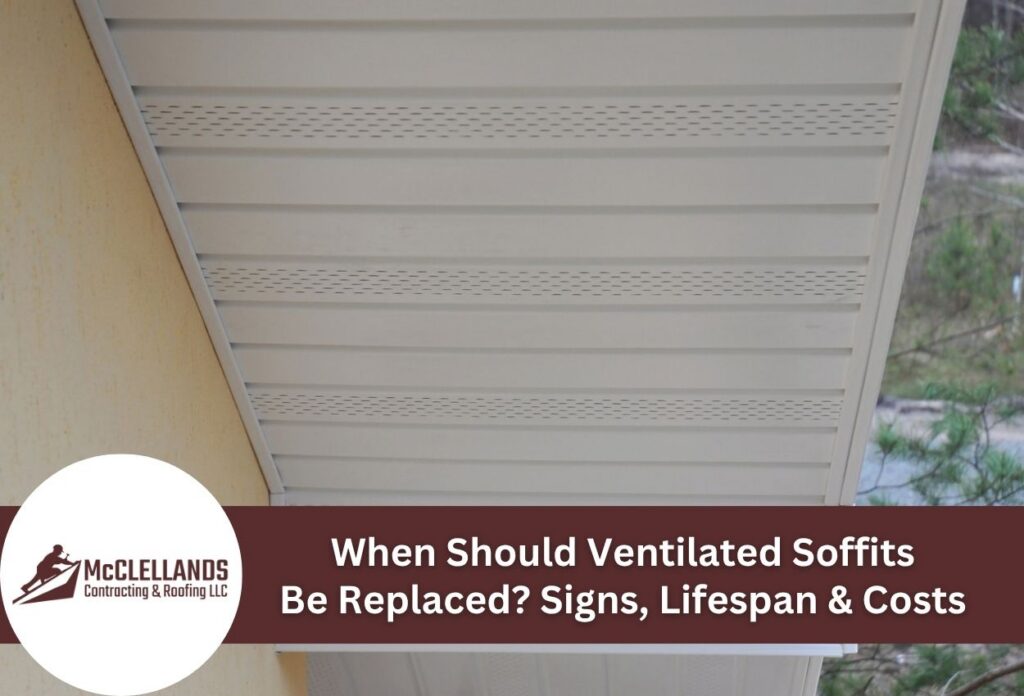

Replacement is typically warranted when any serious failure sign appears (sagging, failed vents across a run, rot, or confirmed pest entry), or when several minor signs appear together, because blocked vents, staining, and peeling paint rarely appear alone.
Most ventilated soffits last 10 to 40 years depending on the material: Vinyl averages 25 to 40 years, aluminum runs 20 to 35 years, and wood soffits in humid climates often fail in as little as 10 to 20 years. Western Pennsylvania shortens those lifespans. The region averages 35 inches of annual precipitation, and repeated temperature swings cause fasteners, seams, and panel edges to expand and contract. That repeated movement works caulk lines loose and lets moisture in faster than drier climates allow.
What Are the Signs That Ventilated Soffits Need to Be Replaced?
Six observable signs of failure point to a soffit replacement, and original wood soffits, which are common in older Western Pennsylvania homes, face higher risks because wood deteriorates faster under the region’s humidity levels than vinyl or aluminum alternatives.
- Sagging or bending panels: Any visible sag or bowing between supports, or panels pulling loose from the channel, means the panel has lost structural strength. This is a functional failure, not a cosmetic one, and it warrants a full replacement rather than spot repairs.
- Paint peeling or bubbling across large areas: Surface fading or a single cracked panel is cosmetic and may only need repair. When peeling or bubbling covers large areas or keeps returning after repainting, trapped moisture is likely driving the damage from behind, making a replacement the right call.
- Staining or streaking along the eaves: Dark streaks running down from the soffit edge signal leaks at the seams or at the fascia board connection. This kind of staining often means water has already reached the rafter tails below.
- Cracked or missing vent inserts: Broken vent baffles block the airflow that keeps attic humidity in check. Multiple failed vents across a run indicate a systemic problem, not a one-panel fix.
- Pest entry points: Birds, wasps, and squirrels target damaged or open soffit gaps. Any confirmed pest entry point means the panel has an opening large enough to cause ongoing structural damage if left alone.
- Persistent attic moisture: Frost, condensation, a darkened roof deck, rusted nails, or a musty smell, especially in winter, point to failed ventilation. These conditions accelerate rot at rafter tails.
If only one cosmetic issue appears, such as minor fading or a single cracked panel, repairs are usually enough. When two or more of these signs show up together, especially any combination involving moisture, rot, or pest entry, a full replacement is the more cost-effective path over time.
How Long Do Ventilated Soffits Last by Material Type?
How long ventilated soffits last depends heavily on the material. Vinyl averages 25 to 40 years, aluminum 20 to 35 years, and wood as little as 10 to 20 years in humid climates like Western Pennsylvania’s.
| Material | Average Lifespan | Common Failure | Maintenance Frequency | Manufacturer Warranty Range |
|---|---|---|---|---|
| Vinyl | 25 to 40 years | Joint separation, UV fading, panel warping | Every 5 years | Limited lifetime (manufacturing defects; terms vary by brand) |
| Aluminum | 20 to 35 years | Denting, paint oxidation, fastener corrosion | Every 5 to 7 years | 40 years to limited lifetime (finish and manufacturing defects; terms vary by brand) |
| Wood | 10 to 20 years | Rot, paint failure, pest damage | Every 3 to 5 years | Typically none |
The Pittsburgh area averages roughly 80 days a year when temperatures dip below freezing overnight and climb above it by afternoon, putting vinyl and aluminum joints under repeated stress as panels expand and contract. Homes with south or west-facing eaves face faster UV deterioration, which can trim 3 to 5 years off the upper end of those lifespan estimates. Wood soffits carry the shortest lifespan and no manufacturer warranty, making them the highest-risk choice for Western Pennsylvania homes. Insulation added to an attic after the original installation can block airflow at the eaves, reducing how well vents function and shortening the effective lifespan of soffits even if the panels themselves look fine.
When Should You Replace Damaged Ventilated Soffits?
Repairs make sense when damage is limited to one or two panels and the underlying system is sound, but four specific conditions point clearly to a full replacement instead:
- Rot in the framing behind the panel or in the rafter tails: Soft or discolored wood behind the panel means structural decay has already started. Once rot reaches the rafter tails, repairs alone will not stop the damage, and a full replacement is required.
- Soffits are within 7 to 10 years of end-of-life for their material: If aluminum or vinyl soffits are already 25 or more years old, or wood soffits are past 10 years, replacing a single panel on a failing run wastes money. Replacing the full eave run is a better decision.
- Attic ventilation is measurably compromised: When the net free area falls below the 1:150 or 1:300 ratio required by the International Residential Code, patching a panel will not restore proper airflow. Replacement with upgraded vent panels (and, where needed, added ridge vents or baffles) is what corrects the deficiency.
- Pest entry has occurred through vent openings: Squirrels, birds, and wasps cause fast damage once inside. If entry has been confirmed, a full replacement with pest-resistant inserts is recommended.
Replacing a typical 100-linear-foot eave run costs $450 to $1,500 depending on the material. Rafter tail repairs, fascia board replacements, permits, and staging can push total project costs to $3,000 or more. Repairs are the right call only when the system underneath is solid, and the remaining lifespan exceeds 7 to 10 years. In Pennsylvania, work that involves rafter tail repairs or structural fascia boards may require a local building permit; confirm with your municipality before starting.
What Does a Ventilated Soffit Replacement Cost in Western Pennsylvania?
Vinyl vented soffits run $4.50 to $8.00 installed per linear foot, the lowest of the three common material options, while wood replacements top out at $15.00 per linear foot once labor is included. The table below breaks down material costs, labor costs, and total installation costs for a typical 100-linear-foot eave run across all three material types.
| Material | Material Cost (per linear foot) | Labor Cost (per linear foot) | Total Installation Cost (per linear foot) | Average Cost for 100 Linear-Foot Eave Run |
|---|---|---|---|---|
| Vinyl Vented Soffit | $1.50 to $3.00 | $3.00 to $5.00 | $4.50 to $8.00 | $450 to $800 |
| Aluminum Vented Soffit | $2.00 to $4.00 | $3.50 to $5.50 | $5.50 to $9.50 | $550 to $950 |
| Wood Soffit Replacement | $3.00 to $6.00 | $5.00 to $9.00 | $8.00 to $15.00 | $800 to $1,500 |
Those base figures cover panel removal, the new material, and a standard installation, but damaged soffit replacements often cost more once the full extent of work is discovered. Repairing rotted rafters, replacing fascia boards, or permit fees in the Pittsburgh metro area can add $300 to $1,200 to the base project cost. Homes with steep or high eaves may also require staging equipment, adding another $200 to $600 depending on the height of the roof and what access is required.
Spring and fall are the preferred times for replacements in Western Pennsylvania. Milder temperatures allow sealants to cure correctly and panels to fit without expansion gaps. Winter installation below 32 degrees Fahrenheit can affect both sealant adhesion and panel fitting. Scheduling work from late April through early June, or from September through mid-October, typically avoids mid-summer heat that can cause panels to expand during installation.
Does Replacing Ventilated Soffits Improve Attic Performance and Home Value?
Functioning vented soffits, working together with ridge vents, help keep summer attic heat down and winter moisture out. Many shingle manufacturers require adequate ventilation to keep their warranties valid, so blocked or failed soffits can put roof coverage at risk. That makes a soffit replacement a performance investment, not just a cosmetic one.
Attic Temperature and Shingle Life
When eave vents fail, heat and moisture build up in the attic, which can contribute to shingle wear from below and put warranty coverage at risk. Restoring proper airflow through vented soffits is a relatively low-cost way to protect a roof that may cost thousands to replace.
Moisture Control and Mold Risk
Broken vent inserts and blocked eaves let moist air linger in the attic, which can keep roof decks damp for long stretches in winter and create conditions for rot and mold growth. Restoring balanced airflow helps the attic dry out, which reduces the risk of mold that commonly costs $1,500 to $5,000 to remove in the Pittsburgh region. Avoiding that cost can justify the project on homes where attic moisture readings are already elevated.
Curb Appeal and Market Value
Upgraded vented soffits improve the visible condition of the eaves, and exterior condition is a documented factor in comparative market analysis. No single data point isolates soffit replacement in home appraisals, but in competitive markets, a clean, well-maintained roofline supports stronger pricing at the time of listing.
When a soffit replacement reduces heat buildup, controls moisture, and improves the exterior condition at the same time, the return goes beyond what the installation cost suggests. McClellands Contracting and Roofing, LLC can assess whether your current roof ventilation is meeting your attic’s performance needs before problems grow.
Ready to Find Out If Your Soffits Need Replacing? Here’s What to Do Next:
Catching soffit failure before rot reaches the rafters can help homeowners avoid structural repair costs, and a professional inspection is the fastest way to know where your eaves stand. McClellands Contracting and Roofing, LLC serves Pittsburgh and the surrounding Western Pennsylvania communities with detailed roof inspections and ventilation services.
Don’t wait for visible rot or pest damage to appear. Contact the team for an inspection now and get a clear answer before the damage spreads.
Not ready to schedule? Learn more about professional ventilation services.